Saturday, March 19, 2016

Fanning island, Kiribati


Lobsters in Lobster pot: 0

Edible fish in Lobster pot: 3!!!


As we head to more and more remote areas of the pacific, and I spend less and less time talking to anyone, it becomes harder for me to relate my experiences in words. There are less reference points, and the essence of my surroundings, as well as my own thoughts and emotions, seem to be of a quality that I cannot quite weave into words. I feel I have slipped into a different reality.


We spent 16 days on Fanning Island, Kiribati, and the place at once revealed itself and remained an enigma. It challenged many of my ideas about happiness, the richness of simplicity and frustrations of poverty, the desire and ability of people to move, grow, adapt and maintain, the traveller's simultanious role of 'guest' and 'stranger', and how to think about change in general, and climate change in particular.


So let me try and do the place and my time there justice.


1. The Place


Fanning Island started life as a volcano, erupting out of the middle of the pacific before slowly sinking down over thousands of years to create a large lagoon surrounded by a thin ring of coral, never more than two metres high, pacific wind and wave lashing against it.


The uninhabited island was eventually found and claimed by a Brit named Fanning who created a coconut plantation. Imported workers from the Cook Islands planted coconuts, taro, breadfuit, and  hauled in their nets full of fish from the reef. In 1984 it became part of  the independent Republic of Kiribati, a group of around 20 islands spread over some 200,000  square miles, home to just 100,000 citizens (some stats!) whose capital, Tarawa, lies over 2000 miles away from Fanning. The Kiribati government encouraged resettlement from other, more crowded islands, and leased land for free to anyone prepared to say goodbye to their loved ones indefinitely and get on the boat east. This migration was further encouraged with the arrival of norwegian cruise ships from hawaii, and for a few years the islanders made easy money selling handicrafts to daytripping americans.


But now the liners are rare and the population of 2000, strung out in villages around the atoll, generally fall into two categories: coconut and seaweed harvesters/fishermen, who lead what can unpatronisingly be called a subsistance living, and a few professionals sent from the capital on four year contracts – teachers, the police chief (his name translates as 'on top', but this is slightly misleading as there are only six other policemen on the island and no one seems to pay much attention to him), the solitary nurse.


The island has resources of fish, coconuts, taro, pigs, chickens,  breadfruit, bananas, pandanus. Every six months a sailing-cargo ship drops off rice, tinned meat, sugar, flour and petrol. They load onto it copra (for coconut oil) and seaweed, and from the proceeds buy tobacco, instant noodles and petroleum products. No doctor and no way to evacuate seriously ill people encourages a slightly more philosophical view of life and death. In the clinic there is a big sign saying 'leprosy is curable'. The disused airstrip hasn't seen a plane for years,  electricity only from solar and generators, no TV (what a thought!), no glass windows, no chocolate. The internet had been broken for 3 months when we got there. Petrol is extremely scarce, but that isn't so bad as there is nowhere really to go that isn't a cycle ride away, unless you are a school child with no bike. The shops sell a small and random assortment of tinned goods from asia, matches, garlic paste and solar lanterns. Things are that simple.


Except they aren't. The weather, according to the locals, has changed drastically in the last 10 years. It rains and floods more, affecting the ground water and washing away roads. The downturn in the chinese economy means that as of last month no one will buy any seaweed, which means some families can no longer buy books or pens for their childrens' schooling. Higher commodity prices mean less rice and flour arrives on the boat. The president of kiribati is currently at climate talks in new zealand, and the official line is that fanning is likely to be uninhabitable in 50 years. His slogan is 'migration with dignity'. The incessant wind and two shipwrecks in the lagoon complete the feeling of isolation. Of course there are other places in the world where people have a lot less (people tell me that no-one is hungry here, and I believe it), but absolute poverty is often offset with wealthier areas (here I am thinking of india), so you get the feeling, probably falsely, that people can move up and down the social ladder, or at least go and live in a city.

The flip side of this is that lots of the diseases that are endemic in larger places have yet to reach Fanning. And we are not just talking about HIV here. Early in the voyage I strugged through the terribly written 'Story of B' by Daniel Quinn, which posits that the almost global attitude of 'produce as much as possible at whatever cost to the environment and other species; value progress and efficiency' is not inbuilt, but one approach among many. However, as part of this approaches' need for incessant growth, and it's incredible efficiency, in the last 300 or so years it has swallowed up other approaches, potentially more sustainable. On Fanning we find that alternative approaches still exist: Here people work extremely hard, but the focus is very much on the present moment, rather than striving for an imagined future, and on living with the land rather than dominating it.

The other major difference is their attitude to visitors. I have known many other places that are extremely welcoming, but here any visitor is an honoured guest, to be given (not sold) everything they need and welcomed like family anywhere they say hello. At times my western, capitalist mind felt wrong and vaguely guilty- I needed exchange for things to be fair! But, as they* say, 'the giver should be thankful', and as they brought whole branches of bananas, breadfruit, more fish than we could eat, out to the boat, I put away these thoughts and gave as much gratitude as I could, knowing that these things were not in abundance and it was really a big display of generosity. On the last day I missed the ferry across the pass. It had got all the way over to the other side before somebody obviously saw me and the whole boat, filled with maybe 50 people, turned around to come back and get me!


II – The People and the Stories


We arrived on the island on a leaden-skied Sunday morning,  after a 13 day, 1500 mile voyage. Our first interaction was a visit from 'customs' – three men (including the blustering On Top) rowing out on a flimsy fisherman's outrigger. One florescent tshirt with the word 'customs' on it , a walkie talkie, a very incongruous pair of black leather shoes which the man ended up not putting on, and only a vague grasp of the neessary paperwork. In short, like an ill-conceived wandering performer at Boomtown Festival.  They asked only for a bottle of rum for payment (they got a box of wine instead) and in exhange gave us an official stamp, and the lowdown on local greetings and local fish. I greased the wheels of beaurocracy with a few glasses of limeade.


Over the next few days the weather oscillated between 'brooding' and 'torrential downpour' but the next day I kayaked to the village and put into practice my well-honed 'walking around looking for the health centre, smiling at everyone and saying hello ('maori' in the kiribati language)' tactic of getting to know a community. Joseph appeared, a retired teacher, who took us to meet bruno 'the frenchman', who came here on a sailboat 30 years ago, got addicted to the island way of life, married a local, and now has the only house on the island made of stone (official buildings are concrete with tin roofs, houses are made from braided pandanus leaves and bamboo). He in turn took us to meet Ty, a fascinating chap – half irish, one quarter kiribati and one quarter maori. He arrived on the island 20 years ago when the cruise ships first started coming, and made money selling phillipino handicrafts to tourists as kiribati originals. With the proceeds he built a cava bar on the island, and started trading in seaweed, built a bakery, generally made good. But now the cruise ships are irregular, the sea is rising, and noone is buying seaweed, and he has got his british passport as an escape route.


We spent a few afternoons in his empty bar drinking tea (me happily given the union jack mug) and telling island stories – the korean man who came and killed 6000 sharks, chopped off their fins to sell in china and has radically altered the island ecosystem. The 9 BALES of cannabis that washed up on shore on the next island, leading to the whole island – even the missionaries – being stoned for a couple of months. Good sermons apparently. The smiling german who spent three tranquil years living on the island, handing out hundred dollar bills like chocolate bars, then disappearing just before the FBI showed up – he had been one of the pilots that had trained the 9/11 bombers. The four local lads who caught fish for the aquariums of the world, storing them in bags under the pier at christmas island. They were checking the fish were ok during a storm when a tidal wave hit, their mangled bodies washing up on the beach a few days later.


But he also explained how people live day to day not only in terms of resources, but also planning – there is no contingency should the rice and flour stop arriving, or the ground water be salinated. There is no word for 'maintainance' in the language. It would be funny if the stakes were not so high. The scientific consensus is that islands like fanning will be uninhabitable in the next 30 to 50 years, maybe sooner, and the Kiribati government has bought land in Fiji for a limited resettlement. But will it be enough for everybody, and how will the people make a living in their new home, never mind retain a sense of identity and an equality with other groups on the island? But then, on the other hand, what can people do to prepare? Go there now? Diversify their incomes or produce on the island? Stop having so many babies? One idea is outlined below, but you see the predicament. The effects of changing weather patterns were clear. It was supposed to be the dry season, yet we could barely dry out our washing. Forty breadfruit trees had just died after their soil became salinated. There are fewer fish in the lagoon.


Another day I ate dried fish with an uncle and nephew copra farming team in a village further north. They showed me the copra preparation process (see the photo with all the coconuts) north. They showed me the copra preparation process and all the things they harvested from the tree – green coconuts to drink then crack open and spoon out the jelly-like flesh; brown coconuts to make coconut cream or copra; the sap from the chopped branch making toddy, a delicious sweet cordial, which can be left for three days to become sour toddy, like cider, or boiled to make a sort of coconut molassus, kamaimai. In typical Fanning fashion he then insisted on filling my big 2 litre water bottle with the latter, precious though it is.


Two doors down from him I was invited by another copra harvester, who I had seen on the ferry, to drink some sour toddy. He spoke no english and had never gone to school, but his partner was the daughter of a school principal and spoke fluent english. She had come to Fanning a few years ago from tarawa, the capital (which is much closer to a 'western' setup) to act as housekeeper for her parents. A local family had asked her father if she could marry their son. He agreed and here she was, a year in, drying copra and staring into space. I had sort of concluded that, whilst I didn't think my lifestyle and priviledges (books, variety of food, electric light, variety of sub-cultures to get involved in) made for a happier or more content existence, I would find it incredibly difficult to move from the lifestyle I knew to this one. And she was doing it. Did she ever get bored? Sometimes. What did she do when she got bored? Dry some more copra. Was everyone happy on Fanning Island? Mostly. Was she happy? At this, she looked at me with big eyes and an inscrutable expression. An expression that could have been saying many things. I was a guest in her and her husband's house and it was inappropriate to probe further. She asked if I had any books she could read. I walked the 90 minutes home on the coral-sand road as the darkness gathered, avoiding big crabs and puddles, the wind whistling through the big coconut palms overhead.


The next morning I was brushing my teeth, watching the ferry (imagine an old school army landing craft) take school children from the other side of the island to the middle school. As it crossed the inlet of the lagoon it was suddenly and violently sucked out towards the ocean by the outgoing tide.


I kayaked over to the gathering crowd on our side of the pass. They thought that there must be a problem with the engine. If there had been an anchor on the boat they could have just dropped it down and at least  stopped moving, but I knew there was no anchor, nor radio, nor life jackets on board, and as we watched some people jump out of the boat and began swimming for shore. Definitely time to do something. By the time I had kayaked back to the boat the rest of the crew were already preparing the boat to go out. By the time we got there, perhaps 20 minutes later, they were already 2 miles out and continuing to drift. Everyone on the boat- around 30 13-15 year olds and maybe a dozen adults – seemed calm and chirpy, though I later found out there had been quite a lot of panic followed by general rejoicing and praising of the lord when they saw our ship begin to move. Apparently one lady said 'they won't help us, they're 'white' ' and then was so happy when it was clear that we were. We strapped the ferry to the side of the boat with ropes and tyres, and headed back. Would have been dodge to make a thing of taking photos but I managed to sneak one just to remember the occasion.
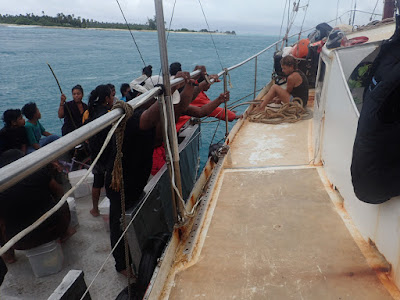


We thought nothing more about it, except that I now didn't worry about not paying for the ferry each morning on my way to school, until we received an invitation to a 'presentation' at the middle school the following friday. Myself and Tom went (I was quite upset that the others didn't come, as it felt like we gave the impression of ungratefulness, but I can only be responsible for myself) and sat cross legged on palm mats on the east side of the school's maneaba, a traditional communal space a bit like a large pagoda, the place reserved for the guests of honour.


There followed prayers, songs, skits, more prayers (the theme for the day was 'ask jesus to forgive your sins'), and then attention was turned to us, and two students danced a wholly ambiguous 'traditional polynesian​ meets christina aguilera' dance for us, and then garlanded our heads and necklaced our necks. Each class then danced and/or sang for us before presenting us with gifts – beautiful jewellery and bowls made from shells and twine, shark-tooth knives, a model canoe, and lots and lots of food for our trip – four sacks of coconuts, breadfruit, papaya, a taro as thick as an elephant's leg. Overwhelming, especially as it was only that morning that I had mentioned to one of the teachers that we were looking for coconuts to take with us. I suspect that the students had given their own lunchtime coconuts to us.   And then the principal made a speech, and then I made a speech, and then there was a special 'thanks for the speech' clap and dance, and then the line of tupperwares that were lined up on one side of the hall that looked so inviting were opened up, and all manner of delights were cooed over, spooned onto plates, and eaten. A giant lobster, sweet and sour beef complete with bits of pinapple, fried breadfruit, pandanus with coconut cream, raw fish with coconut, sweet taro cakes, papaya salad... all washed down with coconut water. Amazing. That night everyone had gone to bed with most of the legs and head of the lobster needing to be eaten or thown away. I made a quick garlic butter and slowly, thoroughly, stripped the animal of it's meat, dipping thick tasty leg meat into the butter and feeling like the luckiest man in the whole world. I don't think i'll need to eat lobster ever again.


III – Learning and Teaching​


I met Atah, the inspiring headteacher of the largest of the three primary schools on the island, early on in our stay, and we agreed that it would be a good idea for me to do some music workshops in her school. She is from the capital island and has a brilliant mix of local and global mindset, and we clicked immediately. She encourages the parents not to beat their children, but also understands what kind of education the children need in the context of this very closed society. She has three children of her own, has adopted a forth and lets a fifth, who is a pepperoni short of a pizza, hang out at her house and eat with the family. She teaches year 1 in the daytime, tutors her friends' children in the evening, cooks lunch for visiting guests, chases up the non payment of her staff, ends up giving away all her crockery to those who have none, and is generally one of those superwomen who often end up in the education sector.


I should say something about this sector in Kiribaati. Primary schools are free, with exercise books and pencils provided by the australian government. This has meant that more children attend school (35 in year one compared to 18 in year 6) but health problems (swollen feet and diorrhea),  transport problems (when the island runs out of petrol or the truck breaks down some children have a round trip of several hours), and parent's prioritisation of coconut gathering mean attendence is still a struggle.


Middle school (11 – 14) and high school (15 – 18) are fee paying, with annual tests providing the top 20% with state scholarships. At sixteen, Fanning's young people must go to boarding school on Christmas island, a 24 hour boat ride away, the capital island, Tarawa, more than 2000 miles away, or to Fiji, New Zealand or Australia. Again, the state sponsers the top 20% of these students.


Studying is mostly in English, so the importance of a strong foundation in the language is essential for those hoping to carry on into tertiary education. With this in mind, I prepared and delivered workshops that integrated spoken and written english and music to all the year groups. I have written further about it here and part of the song we wrote as well as an interview with Atah is here


The other thing that stands out in the schools is the heavy influence of the christian church. One morning I found myself cross legged in Atah's house, machete in hand, shaving the husk off green coconuts to give to visiting missionaries. It got more surreal when we shared the coconuts along with tuna, rice, bread made by laura, honey brought by me. Whilst we ate, Atah got all the teachers together and they started singing – lilting songs beautiful 3 part harmony (one us at the end of the video). Imagine schools in england with a teachers' choir entertaining guests! Then the lead missionary asked me to play and sing a song. The only song I can play and sing with any confidence on guitar these days is 'When Ye Go Away' by the Waterboys, so I duly belted it out as small children peeped in the staffroom windows and crowded in the door. Then I asked the missionaries, dressed in black and white and from both catholic and protestant churches, to sing. They obliged, and I pulled up a chair close by, closed my eyes, and listened. A beautiful sharing.


Atah runs a great school and the kids have a strong and happy education, but of course my western mind looks at the bare concrete walls and floors and says 'let me help this school get more resources'. Perhaps a computer with an offline version of wikipedia (they can run it off solar) or some ukeleles, or even some wall posters or a job lot of footballs. But then I ask myself – do they really need these things? If a child gets used to bright bits of plastic on the wall, or watching youtube videos – however educational – perhaps the seed of yearning for more material goods will be sown in them? And then the next question – does anybody need this stuff? If I fell in love here and wanted to stay, could I actually live so simply, or do I need my fix of match of the day, high quality live music, fish and chips, mature cheddar?


The latter question I have no intention of having to answer, but Atah suggested a penpal scheme to broaden the students' horizons and improve their english. This would be made much easier with a computer and the internet (post takes up to 4 months to get to or from fanning, depending on when the cargo ship arrives), which myself and Laura will fundraise for, and with a bit of luck one or more schools in the english speaking world will see what a great opportunity this is for some cross cultural dialogue and develop ties.


The best way to sell it to schools would be: 'see the face of global warming! This island will be underwater in 50 years, talk to your peers who are on the front line!', but there is something of 'the other' about this approach, and besides, plenty of the teachers I spoke to didn't seem too concerned about climate change...


So yep, Fanning Island, a big learning experience for me. On the last day we got one more delivery of fish and the ferry gave us a royal drive by, with grins and waves and 'sapu!'s all round. And then we pulled up the anchor, hoisted the sails, and set a course north west to get the trade winds to Mujuro, Marshall Islands...


>'They' being a story in 'zen flesh, zen bones'


Tuesday, January 26, 2016

Anaho & Music


Music


Island: Nuku Hiva


Lobsters in Lobster pot: 0


The late afternoon sun creates a dazzling white path on the water, past bobbing sail boats and into the hills, which stand mute grey-green, shadows beginning to lengthen.


It has been a big couple of weeks in the little microcosm that is my world at the moment. Since I last wrote we moved from Ua Huka, itself barely populated and stunningly beautiful, to the north side of Nuku Hiva and a bay called Anaho. Like many of the bays we have been to, this had a beige sandy beach that fronted a steep, verdant vally, mangoes and limes falling off trees everywhere, big rays swimming under the Kayak. But this place felt different. For a start, there were no cars, and the only access was by foot or horse (all the locals used horses) over the hill pass, or by boat (I had a brilliant afternoon where I walked to the village over the hill and found the only visible occupants of the village, a small, fat, laughing 10 year old and his friends, sat with an ipod and a big Bose speaker, playing soca-style drummy pop and gyrating his layers of tummy blubber. I joined them, dancing my most outrageous dance and, after almost dying of laughter, the kids joined in) It also has the only extensive coral reef in the Marquesas, and fish buzz around everywhere. Back in the day ('the day' being between 1200 and 1700 before european diseases killed around 80% of the population) this reef supported over 1000 people, providing the raw material (oyster shells) to make highly prized fishing hooks and trading them across the archipelago. Now the population is around thirty people. They live in houses raised off the ground, and (as previously discussed), don't really seem to need money very much what with hunting, fishing, foraging and gardening, but what money they do make is from producing copra, the raw material from coconuts that goes on to become coconut oil and beauty products. The air is heavy with the slick sweetness of coconut as it drys in the sun. 


We arrived in the bay in the afternoon afternoon, one of two boats in the bay, and the exceptional beauty of the place combined with my return to good health post-infection put me in a wonderful mood. Six weeks into tropical boat life and my body has got the memo – 30 degrees is now normal and not uncomfortable. The bottoms of my feet have thickened so I can walk barefoot, and the tops of my feet are brown enough to no longer warrant sunscreen. My stomach is tolerant with of rainwater and local stand pipes (amazingly, all the water we drink on the boat is harvested from the rain, and we have stored almost 1500 litres for the crossing), and perhaps best of all, my attitude to mosquitos has gone from 'long trousers, deet, annoyance, and constant vigilance' to 'dear mosquito: neither you nor your bites exist'. This new attitude was imparted to me by Heretou, a musician with a voice that should be heard the world over, on the second night in Anaho, as we ate freshly butchered goat with even fresher homemade limeade. I asked him if there were mosquitos here, and whether I should put a shirt on. “it depends on your thinking,” he replied “if you don't acknowledge the mosquitoes exist, they don't bite you. It is the same with ants. If you are still and calm, then leave you alone. If you try and wipe them off, they run all over you. It is instant feedback on your state of mind'. I had had a stressful encounter with ants earlier in the day, so this resonated, and I have been trying out this new relationship with insects ever since, and it really works! I get bitten, but not as much as before, but the bites don't seem it itch hardly at all! Perhaps because I am used to them, but it really improves things, especially when I am with locals and wearing repellent and getting stressed would mark me out as different and, let's face it, deeply uncool. 


Heretou and I played some really deep, communicative, funky music together in the two nights we were there, and he played me the music he is producing, which blends traditional and incandescently beautiful Tahitian and Marquesan songs (with as much as 9 part vocal harmony), with strong beats and electronic elements. Could have been shit, but was infact really good. I learnt his limeade recipe, and I was all ready to settle in, snorkel around the coral, set my lobster net, perhaps write some proper music together (he had logic pro and a good keyboard), maybe find a wife, plant some coconut trees and stay there forever, when suddenly we realised that our food shipment from Tahiti was arriving on the other side of the island the following day (4 days early), and at dawn we waved goodbye to this paradise for the provincial capital, Taoiai (tie-o-why-ee), where we are now (which is, incidently, the location of Herman Melville's Typee, a true story of being captured by a tribe with cannibalistic tendancies). 


I said goodbye to Heretou at midnight, the night before we left, in a big rush as he jumped off the dinghy between waves and I span the boat around to navigate the reef (which I almost grounded the dinghy on twice and was only saved by random big waves that washed me precariously back into the channel). I thought that was it, and was sad as I felt I could learn a lot from this man, but lo and behold, he shows up a few days later in the place we are now and tells me he is going to 'get a few musicians together' for us to have a session. 


Heretou is half french, half marquesan, beautiful, intelligent, light and inquisitive, and I have no doubt could do anything he wanted with his life. After travelling and spending time in Tahiti, he has chosen to build a house in Anaho, the afor mentioned paradise, and has settled down to 'learn the marquesan way of life'- finding his food, growing his food, cooking, understanding the belief and cultural systems of the people. He tells me his days have no routine but usually include a combination of 


  • spear-fishing


  • - drawing


  • - playing and writing music


  • - gardening


  • - cooking 


  • - reading & writing


  • - getting high with his friends


for money he produces copra, or does odd jobs as they come up, such as assisting some kiwi archaologists in the next valley, or being the voice of radio adverts in Tahiti. What a thought, to have each day dedicated to things that are enjoyable, and self-improving, and are based on creativity! We in the west have swapped this freedom for possessions and a promise of a better future, and I think if more people saw that another life is possible, more people would find their own way of reclaiming some of this freedom. I have done it in an extreme way, but for sure there are small things everyone can do to spend more time doing what they love in the here and now. Working part time and reducing consumption (and associated bills), for example. Heretou had told me he was going fishing the next day. When I asked him how it was, he said he didn't go, because he had food left over from the night before. Go figure. 


So anyway, the day before yesterday I got picked up from the dock by a couple of friendly but not chatty guys, as well as heretou, and we drove a little into the hills, stopping at an abandoned building with a river running next to it where everyone got out their pipes and smoked, as apparently the wife of our host didn't like it around the place. Then we drove up the side of the valley, )at times the gradient was so steep it would have been barely possible to walk up) listening to upbeat reggae, and finally arrived at this house that was rehearsal studio downstairs, living space upstairs, and 3600 degree incredible views. Some of the musicians – around 6 in all – were from the band takanini, probably the most famous band in the whole of French Polynesia in the last few years, and I recognised some of them from music videos and a documentary about the band that I had watched before coming. This, and the size of the bass amps, pointed to some Serious Music Making. 


But I made a mistake. With such little language in common, the small amount of communication we do have becomes more important. I had a choice to either play it cool in the way I observe african musicians I have played with in the past, where it is implicit that everyone knows everythign is awesome so doesn't have to say it, or be overenthusastic and english and overblab, which could be endearing or could be annoying. I went for the former, but I think a bit too much. I should have said 'wow, this is an incredible space. It must have been so hard to build such a beautiful, well equipped studio on this tiny, inaccessible island. And I acknowedge that you are all very well respected, rather famous musicians, and it is an honour to play with you' etc. Instead, we arrived, and I petted the dog, which everyone thought was a completely mad thing to do (I assume because they all have fleas. Everyone else kicked them away), and then just sort of pottered around waiting for the music to start. There was an issue with some missing cables and either this, or my rudeness, or something else, made for a really weird atmosphere for the first sort of 20 minutes. We would start to play and it would sound good and then suddenly everyone would just stop playing, and chat in Marquesan with nobody really acknowledging my presence. Then a couple more musicians arrived, with a bass and a big korg synth, and the groove was put on the top of a nail and nailed into the sonic vista, and we played. And we played. And suddenly everything was ok. Reggae, funk, dub, originals and occasionally covers, everyone able to play all the instruments with finesse, the guys swapping around mid song if they had an idea they wanted to try out on a different instrument. A male and female vocalist. A loop pedal used by a left-handed guitar player who played a right handed guitar upside down. Pre-rehearsed arrangements that included sudden breaks and harmonic diversions that kept me on my toes but also allowed me to show my adaptability and willingness to follow the music. Slowly the band leader, whose house it was, actually started acknowledging my existence, and by the end of the 5 hour session he was giving me melodies to play, and initiatin g some pretty sexy synth/clarinet call and response. 


There are, of course, lots of issues around loss of traditional culture and also cultural imperialism and the behemoth of western capitalist culture that they must have been exposed to through the music industry, and it felt like there was definitely a waryness of me that I hadn't experienced in the Marquesas until I came to this town. And I could of handled the situation with more composure. But as the music pitched and rolled around me in that studio on the side of the hill, and there was eye contact and smiles and the groove was so deep my body could not help but move, and the clarinet sounded sweet and on point, I realised that this is what I love doing more than anything else in the world (almost), and this is what I had intended to do in London, but (with the exception of Colin Samurai rehearsals where this happened all the time) got sidetracked by a million other related-but-not-quite-the-same things.


So I was happy, and then came back to the dock to find a big pot luck going on (fruit salad with a coconut and white chocolate sauce) and a jam, and (as has happened at least once before, always with negative outcomes), I tried to enter this jam at the same place I had ended the last one, which was inappropriate, and I got annoyed with myself for playing the right notes at the wrong time with the wrong intention.


And now the days are spent in preparation for the Big Sail to Kiribati. Tom wants the boat in perfect working order, so we have been attaching things to other things (wind veins to masts), taking things (rust and barnacles) off other things, restringing djembes, eating brie. I spent a lot of today sowing thick thread around the ends of ropes to stop them fraying. Now I will head to the internet to send this off and then jump in the (alarmingly warm) sea. 


Yesterday was dramatic, today is ok

Island: Ua Huka
Lobsters in lobster pot: 0

I have always liked the title of that Mum song (the band, not my mum), and finally I can use it in a blog. Except that yesterday was only dramatic in my own head, and (I assume) the rest of the world continues to destroy itself today as much as yesterday.


We have moved islands since I last wrote, and are now anchored in the bay of a village called Hane on an island called Ua Huka, population (of the whole island) 500. Mountain goat population: 3000. Wild horse population: unknown. Getting here involved our first overnight crossing, taking 2 hour shifts on the wheel. A fickle wind and the fact that two of us had never steered a ship before (I don't think Henry's canal boat in Dorset counts) provided challenge enough, but on top of that half way through the night the wind dropped completely, and when tom, the captain, went to turn the engine on, we discovered that the accelerator handle was broken. I am not sure if I was the one that broke it, but as I have been breaking things left, right and centre here (including, as regular readers will know, cracking a kayak) I knew there was a decent chance. The next morning, as I watched tom struggle to do the repairs, I felt like a complete loser. This, compounded by a lack of solitude after exactly a month on the boat and a fresh outbreak of my pus-laden infection, put me in a rather pathetic mood. So I put my last clean pair of socks on over my bandages and went for a big walk.


The scenery was stunning – scottish highlands meets jurassic park. Wild horses roamed about. I stopped at an arboretum where the island policeman, married to the lady at the arboretum, showed me round and gave me as many mangoes, starfruit and grapefruit as I could fit in my bag. Definitely the first and probably the last time that will ever happen. I stopped and ate my ham and mayonaise sandwich at the foot of a huge cross, high on a cliff overlooking the sea. And all the time I was struggling to appreciate the beauty of the situation I was in: I was aware of how amazing everything was, I just couldn't pull myself out of the funk, and the fundamental question in one of the books I am reading boiled to the surface of my mind (sacred path of the warrior): how much have you connected with yourself at all in your whole life?”.

And another quote from someone I can't remember who said 'when you have nothing you come to know who you really are' or something along those lines. And I always thought that meant 'when you are penniless and your wife and all your friends have left you because you are an alcoholic' but actually I think it can also mean 'when all the things you define yourself by (e.g. job, band, friends, routine, collective memories) are no longer there to reinforce the person you assume you are'. But this line of thinking has a flip side – it means you can realign yourself and think about what sort of person you actually want to be and steer in that direction, without all the assumptions (and habitual behaviours) that come from the things and people around you.


And thinking about why I ALWAYS lose stuff and break stuff (as anyone who has spent anytime around me will know). And why I often cook too much food, eat it all really fast, and then am a bit sleepy (or like now, when I am eating a big block of chocolate without really tasting it because I am concentrating on this blog). And why I find meditation very hard to do. And especially at that moment because I was walking through this monumentally beautiful and unique landscape and brain-constipating myself on all these questions.

I realised that I AM VERY RARELY IN THE PRESENT MOMENT. I am always in the past or future or wondering about this or that that has got nothing to do with the information coming from my senses. Does this sound like a big revelation to you? To me, at that time, it was pretty big. And I think of people that do seem more in the moment, and I realise it is those people that I really respect and admire, and I think of people who are anxious or carry big burdens around with them and realise that they too seem to rarely be in the present moment.


So currently goal number 1 is: be in the present moment. Practice: Good posture. Eating slowly. Really listening to what people are saying and the meaning of it. Lingering longer with my eyes ears and nose aware of my surroundings (easy here as everything is as if moulded for an elaborate eco-fantasy film). Russell brand says in his book 'revolution'* that the strongest common element in all religions/self help books/spritual systems is an urging to be in the present moment.

I'll let you know how it goes.

* Russell Brand has always struck me as a total knob, and I thought his move into anti-capitalism, pro-systemic social change would be brief and gauche, but actually listening to him read his audiobook (I am about half way through), I have to say that my views are extremely similar to his, and he discusses the ideas of interesting and diverse people, from david graeber to rumi. And it is, in part, very funny. He should probably relieve himself of the vast majority of his money to really be able to speak with any credibility, but perhaps my automatic distaste for him was another example of me not living in the present moment and making assumptions... some of his ideas include cancelling all personal debt, banning titles (e.g. sir, the honerable etc), and banning personal security. All of which are themselves quite revolutionary I think.

Location:Ua Huka

Tahuata


“What I like best in the whole world is Me and Piglet going to see You and you saying 'What about a little something?' and Me saying 'Well, I shouldn't mind a little something, should you, Piglet,' and it being a hummy sort of day outside, and birds singing.”


I am reading 'the Tao of Pooh' at the moment, having just finished 'Candide' by Voltaire, two perfectly appropriate books for these last days. 


We are anchored off a small island called Tahuata, in a bay known locally for the pods of dolphins that hang out here. They come each morning and evening, around 20 fins cycling around, occasionally flipping and spinning. I have been out to kayak amongst them, and hope to swim with them before we go. To convey the scene and mood of the bay stretches my descriptive powers to the limit, and I fear I will come across a bit boasty, but I think if I write it down it will seem more real. 


I must start with the colours of the sea. Jade with a sheen of turqoise, moving in patches to a heavy navy, the sun and gentle swell shifting patches of silver at 45 degrees. To the west, open ocean radiates patches of brilliant white where the sun comes through the clouds. Curving from north to east to south is the bay. At it's base, boiling white waves suddenly vicious on rocks. Above, a metre or so of bare black volanic rock, not going anywhere, then the green begins, everything arching out over the sea to catch as much sun as possible – hundreds of coconut palms, fat yellow coconuts visible from the boat. Trees and bushes, the passing clouds moving zeppelin shadows over them. The ridges and peaks maybe 300 metres high, tapering down to the north and south. The masts of the four other boats in the bay like matchsticks in front of a cooker. Our boat, on just one anchor, arcs slowly with the current, providing a constantly shifting panorama for those too lazy to move their own head from side to side. The same 30 degrees celcius it has been for the last 3 weeks, placated by a rising and falling breeze.going anywhere, then the green begins, everything arching out over the sea to catch as much sun as possible – hundreds of coconut palms, fat yellow coconuts visible from the boat. Trees, bushes, the passing clouds moving zeppelin shadows over them. The ridges and peaks maybe 300 metres high, tapering down to the north and south. The masts of the four other boats in the bay like matchsticks in front of a cooker. Our boat, on just one anchor, arcs slowly with the current, providing a constantly shifting panorama for those too lazy to move their own head from side to side. The same 30 degrees celcius it has been for the last 3 weeks, placated by a rising and falling breeze.


Time has flattened. I took my watch off a few days ago to see what it would be like. Strange at first but, for now at least, the days have seperated not into minutes and hours but into meals and sleep and the time in between each. I wake up at dawn with at best a vague idea of the programme for the day, and over crepes and homemade mango jam people state their intentions for the day and any work that needs doing. From this vague beginning the days seem to fill themselves -albeit at a leisurely pace- and before I know it I am settling down with a cup of tea to watch the sunset and play a little mbira. 


Yesterday was one such day. I had a single aim – to kayak 2 miles to the nearest village and go to the clinic to pick up some fresh bandages (the final symptom of the infection I have had the last few weeks is a big hole on the top of my right foot). All was going well until I tried to land the kayak on a particularly tricky jetty. The swell made the kayak rise and fall, but was never quite high enough to get a good grip on the slippery rocks. I tried playing it safe for a while but wasn't getting anywhere, so I took a deep breath and Went For It. The odds were against success, and sure enough I ended up in the water, the kayak was upside down and rocking about, and it took a good few minutes of dodging waves before I finally managed to haul myself and then the kayak onto land, heart beating fast. And oh no! Big crack in the kayak. Daylight visible through the hole. Shit. So I left the kayak on the dock, still noone else around (the village has maybe 100 people in it) and went to the clinic, which seemed to be the local transexual hangout (gender bending is an accepted part of the culture here), and got a fist full of bandages from the nurse there. Objective 1: complete. But what to do about the kayak? I decided the best course of action would be to hang around and chat to people for a while. After a strange conversation with some local youth trying to trade fruit for first whisky then cocaine (ignoring my repeated explanations that I had neither), surely enough I met the man who operated the local JCB, and he had some epoxy resin, so we went to look at the kayak and then he went home and came back with the resin, mixed it, and I slapped it all over the crack. He assured me it would dry in an hour or so, and (on his request) I bought him a big bottle of coke to say thanks, and then he went off an reappeared with a half dozen grapefruit as a gift for me. So there I sat, in the tiny bit of shade I could find, eating grapefruit and peanut butter and reading herman melville's typee, waiting for the resin to dry. 


I waited and waited and then the sun moved behind a cloud and it began to rain. Que lastima! The resin isn't going to dry now. Having missed the only boat back to my home bay, and not wanting go back without the kayak, I was in a bit of a pickle. So I decided to hang around a bit and see what occurred. 


After a while imspotted some kayaks heading towards me, and who should appear on a kayak but melanie, a french singer from the last island we were on, and the man whose boat she was staying on. Allah akbar! I asked them straight up if they could give me a ride home on their boat and they said yes. But first they had to fill their water, pick some fruit, then we all went back to their boat, me paddling fast but the epoxy holding ok even though it was wet still, where we ate meatballs and spaghetti and then they took me the couple of miles home. 


Now that we have moved to a bay that doesn't have loads of other boats dirtying the water, lots of water-based activities have got going. The hull has been cleaned, the coral admired, and people have dived into the sparkling sea from various parts of the boat and rigging. However, the chief activity is spear-fishing – swimming around with a snorkel and flippers and a big and mean looking speargun and shooting fish. Sounds simple but actually is both physically and mentally very demanding. Three people go out – two with spear guns, plus a support kayak to store any fish that are shot. Due to the hole in my foot, I have only been able to kayak so far, but it has been very good to watch Tom in action: he snorkels slowly, looking for an edible fish (some contain toxins from the coral and are inedible). When he sees one, he floats face down in the water for a second, then slowly, as if in slow motion, he dives vertically down to around 10 metres (but sometimes up to 25 metres!) where he waits poised (at 10 metres his weight is equal to the water so he neither rises or falls) before releasing the spear into the head of poor mr fish. If he is successful, he grabs the fish and holds it above his head as he ascends to the waiting kayak, before the sharks can steal it from him. The other diver uses her speargun to gently push away these sharks. Watching this and doing a bit of deepish snorkelling myself as I start to train to be a Badass Hunter, it becomes so clear that we, floppy, oxygen dependent humans, are in alien and hostile territory when underwater. Many dangers, no easy catches. a cr. 


So to mitigate our corporeal weakness, sometimes we need to use those big, dangerous brains of ours... I have been using mine to design and build a lobster net! Looks like this:


Built from plastic netting, string, cable ties and a tin can. I am immensely proud of it, but this pride is suspended until it actually CATCHES a lobster, which after 2 days in the water it hasn't yet. 


The few locals around also seem to spend a lot of time fishing and hunting. There are wild goats, pigs, chickens and horses on this island, and in preperation of any big party (especially weddings), groups will head up into the hills for a day or two and come back with enough meat for a feast. In these more remote valleys it is possible to be almost self-sufficient, and it seems that the only use locals have for money is to buy petrol and alcohol. Despite being a person who neither makes nor spends much money, this way of living I find so hard to imagine. But examples of it pop up here and there – last night a boat pulled up next to us, the three drunk and exuberent men inside offered to exchange meat and fruit for rum. We poured out half a bottle for them and they came back with a big tupperware of delicious meat with various fruits. We ate royally.

Sunday, January 03, 2016

New Year, Food, Finding a Role

Well, new years afternoon here, just after midnight in england. Sitting thronelike on the roof of the boat as a shower blows through. I have just resecured the tarp that is covering the vents of our fruit dryer - a contraption that has the same shape and principles as a bamboo steamer, but is made of netting and hangs from one of the masts. Coconut, mango and papaya. A fine sight but am dubious about whether anything will actually dry in the fairly high humidity here.
Food and eating have been dominating discussion on the boat these last few days as our departure from Hiva Oa draws closer. We are putting an order in for 3 months worth of food (worst case scenario) to a lady in Tahiti. She will buy it and put it on a ship that will meet us in Nuku Hiva, the last island on the Marquesas before 1500 miles of open ocean to Kiribati, which apparently has no spare food, and then another 2000 to the Marshall Islands. What to take? A shopping list is proposed, discussed and generally agreed upon. Jan and Laura, the two newest crew members, are well keyed in to both nutrition and where food comes from and have a natural - and perfectly justified - aversion to highly processed, ethically dubious foods that I scoff down with little thought. Better to be around people on that side of things than the other, but I did make a robust (but ultimately doomed) argument for peanut butter. I didn't mention thatthe only kind you can get here is the american kind, which is basically palm oil and sugar, and has the same guilty addictiveness as smoking. Instant noodles made it onto the list though, as did processed cheese (the only kind of cheese for miles around it seems). And lots of the sauces and spices, based on the assumption that we are going to catch loads of fish. So good quality soy sauce for sashimi, and butter, cream and herbs for the french cooks.

But the other side of this is how we can preserve perishable food available on the island for the journey. Hence the fruit drying, and a trip by me round to all the other boats, my french level set to 'understandable yet highly flawed with accompanying naive grin', to ask for empty jars to make mango jam. Big success. Mushroom spores are being injected (endless oyster mushrooms in 6 weeks time), coconut dessicated, chillis and garlic set in olive oil. Lemons put in sand (no joke). Lots of work for relatively small quantities, but so interesting to learn.

The whole crew are here now, the last arriving yesterday. We are five and, though not famous, Enid herself would have stuggled to find a skill set more suited to an adolescent adventure book/tv series. Tom, the captain, picked up the boat 10 years ago in hong kong and can repair every part of it quickly, probably using material he found at the bottom of a coral reef or that he magics from a corner of the engine room. A captain at 24, lucky to be alive after a barracuda bit off half his forearm in cuba a few years ago, with the boat as much a part of his identity as 'unsung hero' is part of paul scholes'.

Emma, also french, quit her high flying job in paris after couchsurfing with tom whilst on a holiday to see her brother in tahiti, and has been here ever since. Amazing cook (lobster her speciality, which i am told we will be eating a lot of) and takes responsibility the logistical details - money, supplies (food and medicine) with the efficiency of someone who has made a profession of it.

Jan, czech, tall and strong, cares about plants - growing them, foraging them, eating them, saving them. He has dedicated most of his adult life to developing his skills and knowledge in different parts of the world, and when with you, will give you things to eat and smell and morsels of information about a world i rarely think about. Did you know, for example, that fruit still on a tree holds more water during the full moon (and vica versa)? So if a farmer wants to sell his fruit, he harvests on a full moon so the fruit are bigger, but if he wants to dry his fruit he picks it on a new moon. Cool. Each day Jan sets off with his backpack and returns a few hours later heavily laden with of coconuts, chillis, mangos, breadfruit, grapefruit (it helps that there is fruit dropping from trees all over the place). Likes to go to bed early. Great guy to have around.

Laura arrived the other day having just finished walking 3000 miles from the coast of australia to the middle. Realised she missed the sea, and so  here she is. Outdoors instructor by trade, her first aid skills are comfortably in the realm of 'medic'. Resourceful and grounded and reminds me a lot of Behla.

And then attached to this dream team like a advertising supplement to a newspaper is me, currently especially useless as i have a blood infection that manifests in particuarly ugly, pussy eruptions on my skin, and a swollen right foot, so i am hobbling about in an ungainly fashion and accidently leaving used bandages everywhere. This body was forged to stand up to the north sea and wind and doesn't know how to handle itself in the heat, sweat and insecty world of the tropics. So first it burnt and then it itched and now, seemingly, it has melted. But we are learning together, and I need to cut it a bit more slack.

But i digress. It has been a good process for me to initially think my skill set was useless out here: music is all well and good, but doesn't feed anyone, and there are no children on the boat to provide education to. Like a lot of people, i tend to value myself on what i can DO, and am seen to be doing: creating, producing, having something interesting to say, making money, being unique. But in comparison (comparisons, as someone once said, are odious, but here we are) to these dudes I possess merely an adequate amount of strength, wit, life experience, revolutionary zeal. Nothing to puff my chest out at. And on acknowledgement of this, the challeng is to learn to be ok with just being a person that is there, sharing time and space. And perhaps at the heart of it is the need to be respected, revered and perhaps even loved  by others - validation of your existence. When that is gone you find out if you respect and love yourself. It has also made me think about what i do have to give to this situation, and what attributes I have learnt in the past that are relevant here and, crucially, what I want to spend time developing. Skills, of course, but I am thinking more like patience, discipline, self-control, non-judgement, ability to react spontaneously with the correct intent.

One thing I can do very well though is sit around and eat home made pizza and  drink rum and play music and get to the heart of matters.   That was our new years eve, with romano and the gang, and it was great (I now write after new year).

We set sail in a few days, so not sure when next blog will be up. I think there is a way of subscribing if you want to get a nudge...

In the meantime, happy new year

Monday, December 28, 2015

Christmas on the boat

It is christmas day 2015 and too late in the afternoon to nap satisfactorily before it gets dark. Day 13 on the boat. I have wanted to write about what it is like here for a good few days because there is much going on both within and without, and a snapshot a week ago was so different from the one I will try and develop now.

I wake up sometimes with a vague panic that I don't know who I am. It is usually around 615am and the sun has just come over the hill to hit my body lengthways as I lie foetal on the roof of the boat. I open my eyes to the water, a dozen or so other sailing boats, and the hill itself, deep green, palmed, sometimes with an icing of mist. I grope sleepily for points of reference, a day of the week or the time in relation to the time I have to leave the house, or at least a curtain to open, and then take a breath and remember that things are not working like that at the moment. Or to put it another way, It is like climbing a beautiful old californian redwood. Each branch is a joy to climb up, with a great smell and a feeling of reaching an eventual goal, but if you look down you think realise that much of what you have learnt and your behaviour patterns on the ground are entirely irrelevant up here in the tree, and when you look up you can't see the end point, despite the fact that you know it is there. Now imagine that you don't know that the tree ever ends, and there is no one else in sight. Similarly, as I move through each day here it is delight upon delight at every turn, but when I take a step back and look to the present in the context of my past or future... well it is better to just stick in the present.

And so in that present I usually find the rest of the boat already up, with someone making crepes or slicing mango or back from the shop with some baguettes to eat with melted butter and fig confiture (we are on a french boat after all). In fact the food is quite special both on and off the boat. This comes in part from the fact there is little diversity of ingredients, but what there is of high quality – we are basically talking fresh fish, meat and fruit. A guest turned up to a party yesterday with a slab of raw tuna as big as my forearm instead of a bottle of wine. Dozens of ripe mangoes fall from the trees along the road and are eaten with limes, coconuts, guava, mexican cherries, star fruit, pineapple. The pineapple skins are fermented to make delicious cider. The lemons and limes 'cook' raw fish. Barbecues abound. My bowels were dubious at first, but have now embraced. This food thing, coupled with striking hilly vistas, ideal climate, warm ocean, and a friendliness of the people that is genuine and unbounded without being pushy or invasive (I have never had to wait for more than 5 cars to pass before getting a ride when hitchhiking into town) gives the feeling that you are in paradise. The weather is sun with light breeze and occasional cooling rain. The internet various between 'very slow' and 'off'. The waves in the northern bays are consistent for bodyboarding.


And what does one do in such a place? Well, the heat in the middle of the day lends itself to doing not much, but in the mornings I kayak around, play music, do the dishes, the odd bit of yoga, go walking in the hills. And everything takes a lot longer here: washing clothes, for example, took a whole morning- do the washing up so the buckets are empty, kayak the clothes and buckets to the tap on land, hand wash, row everything back, stop for a chat with another boat on the way, hear about a party, figure out a way to hang the clothes so they won't fall into the sea as they dry...and on. But nothing is a chore and all can be done in a (dare I say it) mindful way. My mind used to be occupied by lesson planning, getting from A to B in london, whether or not everyone in the band was going to show up for rehearsal, how to not be so annoyed at hipsters (they are, supposedly, human after all). Now the questions are 'how do I prevent my knife getting rusty' 'how can I arrange this djembe and calabash on the kayak so they won't fall into the water' 'what book shall I read next'... I am not saying the latter are better things to be thinking about, but it does make a nice change, and my contentment or lack of hinges on them in the same way, though there is an overriding sense of tranquility that I found hard to find in London.

One of the best things about being here, though, is the space I have reclaimed in my life for music. In London, the more successful my playing and teaching of music became, the less time I had to just lean back and Play. Here there are instruments, and time, and loads of musicians around the place. I feel that my improvisational abilities are weaker now than they used to be, but other aspects of my playing are more solid, and I have started improvising on mbira again, which I haven't done for a long time. A few nights ago, maybe four, I ended up jamming with an amazing guitar player, arabic maqam, both of us singing and playing, when we were joined by two local guys – Maori and Poi – who had played drums for one of the dance groups in the festival (see the last blog post). The next night they returned with their percussion and drums and we used their traditional rhythms as the basis for something really hot.

The following night I invited them for a meal on the boat, and knowing that polynesian hospitality, like iranian hospitality, has a 'give everything to the guest' mentality, I thought about what I could provide, and came up with: food, beer, other musicians, a party. So the next day was taken up with finding and transporting the right food, and letting people know that there was a party. It was like being in the penultimate scene of a winnie the pooh book. At sunset I collected them from the shore and the boats trickled in, some with musicians, some with rum, and the great thing was that everyone else spoke french, so my guests were able to communicate more freely than with me alone, and everyone became at ease, and I could focus on music and cooking supervision.

Romano and his accordion arrived and someone produced a tahitian ukelele (double stringed with no resonating chamber) and a guitar, and suddenly a few new dimensions and possibilities were added to the music. The marquesan guys would play a few songs, us accompanying, then they in turn would accompany some french tango or, at one point, the internationale :). Everyone was up for playing and had some form of instrument, and the subtle energy that rises and falls dependent on the collective consciousness of the group picked up speed until the feet started stamping, then dancing, then twirling, and the voices purred, then sang, then wailed, then laughed. I was enjoying myself so much, not having to be a 'host' and make sure everyone was ok, but nevertheless having managed to create my ideal situation – diverse musicians playing diverse music, everyone enjoying, and I could just play and listen and not have to talk to anyone.

The next day – christmas eve – Maori took me to his home where his wife and four children were limbering up for christmas. From what I gather, Maori came to this island 21 years ago, chasing a girl (now his wife) who was part of a very big/well known/influential family on the island. My guess is he had to prove himself, and he did so by building for them a beautiful big house, surrounded by fruit trees (and cashew nut trees – did you know the cashew tree also bears an apple/guava like fruit that is sweet and tasty?), learnt the local Marquesan language, won a few surf competitions and now drums for the island dance group. Some life.


The thing they keep saying to me is 'tranquil ben, tranquil' and doing a sort of 'pushing the palms down to the ground' motion with their hands. This is certainly the overriding philosophy of the island, which I would sum up as 'take it easy, but take it', but I am not sure whether they are telling me this because they want me to know that despite our limited language, we are comfy in each other's presence, or whether they sense in me a restlessness or seriousness or overanalysis (something people occasionally accuse me of) and are telling me to chill the fuck out. Or whether that is just their way of saying 'everything is cool'. Either way, I really enjoy their company. Poi is a tattoo artist and offered to tattoo me. I toyed with the idea and looked at one of his books of drawings but nothing really grabbed me, and then I saw how he had decorated the christmas tree and decided that, well, perhaps we had different aesthetic tastes.

The next day, christmas day (I am now writing on boxing day) we all went to church . Don't know if I have said this before but churches are one of the only places you can go for just a donation and see a true cross section of a community doing something that is an integral part of their identity, and be accepted immediately. There are lots of reasons besides a belief in the christian creed to go to church. This church was all decked out with palms leaves and brightly coloured balloons that said 'merry christmas' in english, and the music was a man with a guitar and a deeply resonant bass voice, with a handful of strong female singers. Polynesian harmonies and lyrics, but a couple of hymns that I knew the english words to! So funny to hear, and a christmas treat! Of course the whole missionary thing was very destructive and, in my opinion, fundamentally wrong, but 500 years later you have to accept that this is the belief system of many Marquesans, and to criticise that would be to continue to think we know better than them, which or course we do not. Scientologists on the other hand...


Afterwards we bought some beers and drove to the north side of the island to Haianapa, a bay with good waves, where Marquesan families were spending their christmas day barbecuing, hanging out in the sea. We swam and chatted and walked around, and then came home. In the evening I rowed over to Romano's boat and we drank some rum and talked about rats and Marseilles and marriage and whether or not providing socio-economic relief (i.e. charity and ngo stuff) in a capitalist society is infact supporting that society. Concluded: Probably yes, but that doesn't mean it is not a good thing to do.

A good christmas.

Matavaa o te Fenua Enqta

Festival of the Arts of the Marquesa Islands


The history of the six islands that make up the Marquesa Archipelago goes something like this: a few million years ago, a set of volcanoes erupted in the pacific ocean, not too far from the equator, forming islands that shoot straight out of the sea, up steep slopes covered in lush green vegetation and igneous rock, deep inland valleys, a few beaches and natural harbours.


A few million years later, around 200AD, humans migrating south east asia in 'outriggers' – big double hulled canoes with sails – arrived, and named the place 'the land of men'. The Spanish arrived in the 1500s, followed by the french, who colonised the whole of what is now French Polynesia (Tahiti being the main island) and, along with passing whaling ships and merchant vessels, introduced gunpowder, christianity, syphilis and alcohol onto the islands, bless 'em. The result was a decimation of the population- some estimates say the population of the Marquesas dropped from 80,000 in 1700 to just 2000 (!) in the 1920s.


With this population decline came a loss of traditional cultures and values. However, since the 1980s there has been a quite amazing movement to reclaim some of this heritage- specifically the dances, music and tattooing. Every four years delegations of around 150 (less from the smaller islands) get together and perform these arts over a period of four days. It is a big deal. For starters, the population of Atouna on Hiva Oa, where this year's festival is taking place, is around 1500, so the population of the town more than doubles – temporary restaurants are built out of timber and palm, delegations of dancers welcome each island as they arrive by boat with a song that still rings in my ears (being on a boat in the harbour we were able to watch this each day), the village bakery works overtime to produce bread for the masses, two french naval frigates hang around in the bay, helping to move people between islands, sailors incongruous in their starched white uniforms.


On the first day there is a parade, with each island in their own traditional costumes, performing mini dances and listening to blah blah speeches from this man and that. Things get serious on days two and three, with each island performing a 90 minute ish set of dance-dramas with pounding percussive orchestra – I counted 25 drummers in one group, the biggest drums over two metres in height, players standing on stools to play them, a sound like a Giant pounding an oak tree on hard ground, visceral and warlike.


Indeed the men's dances are war dances, dozens of men of varying ages executing intricate Hakas in perfect synchronisation, jumping, turning, chanting. The women's dances were much more elegant affairs, with beautiful songs, the famous bird dances, me falling in love at every turn. And then together there were stylised courtship dances, the recreation of origin stories (one island used a full size outrigger as part of their dance, carried on the shoulders), twice live pigs were sacrificed as part of the dance. My favourite involved a missionary dressed in a white robe and brandishing an over sized cross being initially feared but quickly killed, his body carried off. A big cheer from the french section of the crowd, but I imagine maybe some conflicting loyalties among the many christians Marquesans.


And then there was a feast. In the true medieval, Asterix and Obelix sense of the word. Several (maybe 20?) pigs had been roasting slowly in homemade underground ovens for probably a day or so, and at 11am on day 2 the men from each island dug up their pigs with much (very aggressive) singing, decanted the meat and carried it on huge bamboo rods to a series of small marquees, where the women had already laid out all manner of delights I had never seen before – breadfruit, green grapefruit, a sort of polenta coconut milk pudding, small crabs, shellfish, bite sized chunks of raw white fish- and many more things I could name only by colour and taste. The platters of pork were added to the table and we ate and ate some more, using coconut shells as plates (plastic was banned from the meal, and alcohol from the whole festival). Special times.


The thing that made the festival so unique, and at times so surreal, was how participants were blurring the line between recreating a past traditions as a means to assert identity and pride, and actually being the people presented in the dance. Marquesan men still hunt on horseback, use tattoos as part of a passage to adulthood, take pride in their strength, seduce women by being the best dancer/general dude around. And why not? They do not, however, use plant fibres as clothes or attack other islands. To what extent were the dancers expressing their own identity, and how much was part of the dance?


This question didn't seem to be in the minds of the passengers on the Arai Nui, the exclusive cruise ship that was in dock for two days of the festival, passage on which costs around $5000 for a two week trip. It was an anthropologist's worst nightmare; 1500 marquesans attempting to recreate a tradition – their tradition – that involved beautiful, sophisticated dancing and music but also happened to involve grass skirts, ritual sacrifice, necklaces of bones, a history of cannibalism and lots of almost naked people. A group of rich, privileged americans (mostly) with camera lenses bigger than their brains, completely ignoring the purpose of the festival – to preserve traditional culture – and instead acting like they were in disneyland, getting in the way of dances to take photos, pushing to get food first, taking more photos, sitting on tikis (statues), taking more photos, switching cameras and taking more photos, arriving late, leaving early, leaving cans of sprite and cigarette ends on the floor in a place that doesn't have the luxury of never seeing it's waste again once put out of the house in a big green bin. Seeing the Marquesans primarily as one big photo opportunity to show the kids at christmas while the turkey juices run off. It completely fucked me off (and others I spoke to) and made me want to write to the organisers to apologise on behalf of my culture. And suggest a ban on cameras along with alcohol in four years time.


The festival ended with a massive drum and dance off, with all the drumming groups gathering tight and improvising together,a wall of sound, and dancers from different islands improvising parts of their dances while everyone looked on. Certainly a once in a lifetime experience, and well done (almost) everyone.

Recipe a Poisson Cru de Polynesia (Recipe for raw fish with coconut milk)


Ingredients:
Red Tuna
Coconut milk
Red peppers
Cucumber
White onion
Salt, pepper
Limes/lemons

1. Open coconuts, shave off flesh, and strain in a teatowel to create coconut milk
2. Chop fish and veggies into pieces as big as the top joint of your little finger, with exception of onions, which should be very small.


3. Mix together.


4. Leave for 45 mins for flavours to infuse
5. Add lime juice and serve immediately with rice.