Monday, December 28, 2015

Christmas on the boat

It is christmas day 2015 and too late in the afternoon to nap satisfactorily before it gets dark. Day 13 on the boat. I have wanted to write about what it is like here for a good few days because there is much going on both within and without, and a snapshot a week ago was so different from the one I will try and develop now.

I wake up sometimes with a vague panic that I don't know who I am. It is usually around 615am and the sun has just come over the hill to hit my body lengthways as I lie foetal on the roof of the boat. I open my eyes to the water, a dozen or so other sailing boats, and the hill itself, deep green, palmed, sometimes with an icing of mist. I grope sleepily for points of reference, a day of the week or the time in relation to the time I have to leave the house, or at least a curtain to open, and then take a breath and remember that things are not working like that at the moment. Or to put it another way, It is like climbing a beautiful old californian redwood. Each branch is a joy to climb up, with a great smell and a feeling of reaching an eventual goal, but if you look down you think realise that much of what you have learnt and your behaviour patterns on the ground are entirely irrelevant up here in the tree, and when you look up you can't see the end point, despite the fact that you know it is there. Now imagine that you don't know that the tree ever ends, and there is no one else in sight. Similarly, as I move through each day here it is delight upon delight at every turn, but when I take a step back and look to the present in the context of my past or future... well it is better to just stick in the present.

And so in that present I usually find the rest of the boat already up, with someone making crepes or slicing mango or back from the shop with some baguettes to eat with melted butter and fig confiture (we are on a french boat after all). In fact the food is quite special both on and off the boat. This comes in part from the fact there is little diversity of ingredients, but what there is of high quality – we are basically talking fresh fish, meat and fruit. A guest turned up to a party yesterday with a slab of raw tuna as big as my forearm instead of a bottle of wine. Dozens of ripe mangoes fall from the trees along the road and are eaten with limes, coconuts, guava, mexican cherries, star fruit, pineapple. The pineapple skins are fermented to make delicious cider. The lemons and limes 'cook' raw fish. Barbecues abound. My bowels were dubious at first, but have now embraced. This food thing, coupled with striking hilly vistas, ideal climate, warm ocean, and a friendliness of the people that is genuine and unbounded without being pushy or invasive (I have never had to wait for more than 5 cars to pass before getting a ride when hitchhiking into town) gives the feeling that you are in paradise. The weather is sun with light breeze and occasional cooling rain. The internet various between 'very slow' and 'off'. The waves in the northern bays are consistent for bodyboarding.


And what does one do in such a place? Well, the heat in the middle of the day lends itself to doing not much, but in the mornings I kayak around, play music, do the dishes, the odd bit of yoga, go walking in the hills. And everything takes a lot longer here: washing clothes, for example, took a whole morning- do the washing up so the buckets are empty, kayak the clothes and buckets to the tap on land, hand wash, row everything back, stop for a chat with another boat on the way, hear about a party, figure out a way to hang the clothes so they won't fall into the sea as they dry...and on. But nothing is a chore and all can be done in a (dare I say it) mindful way. My mind used to be occupied by lesson planning, getting from A to B in london, whether or not everyone in the band was going to show up for rehearsal, how to not be so annoyed at hipsters (they are, supposedly, human after all). Now the questions are 'how do I prevent my knife getting rusty' 'how can I arrange this djembe and calabash on the kayak so they won't fall into the water' 'what book shall I read next'... I am not saying the latter are better things to be thinking about, but it does make a nice change, and my contentment or lack of hinges on them in the same way, though there is an overriding sense of tranquility that I found hard to find in London.

One of the best things about being here, though, is the space I have reclaimed in my life for music. In London, the more successful my playing and teaching of music became, the less time I had to just lean back and Play. Here there are instruments, and time, and loads of musicians around the place. I feel that my improvisational abilities are weaker now than they used to be, but other aspects of my playing are more solid, and I have started improvising on mbira again, which I haven't done for a long time. A few nights ago, maybe four, I ended up jamming with an amazing guitar player, arabic maqam, both of us singing and playing, when we were joined by two local guys – Maori and Poi – who had played drums for one of the dance groups in the festival (see the last blog post). The next night they returned with their percussion and drums and we used their traditional rhythms as the basis for something really hot.

The following night I invited them for a meal on the boat, and knowing that polynesian hospitality, like iranian hospitality, has a 'give everything to the guest' mentality, I thought about what I could provide, and came up with: food, beer, other musicians, a party. So the next day was taken up with finding and transporting the right food, and letting people know that there was a party. It was like being in the penultimate scene of a winnie the pooh book. At sunset I collected them from the shore and the boats trickled in, some with musicians, some with rum, and the great thing was that everyone else spoke french, so my guests were able to communicate more freely than with me alone, and everyone became at ease, and I could focus on music and cooking supervision.

Romano and his accordion arrived and someone produced a tahitian ukelele (double stringed with no resonating chamber) and a guitar, and suddenly a few new dimensions and possibilities were added to the music. The marquesan guys would play a few songs, us accompanying, then they in turn would accompany some french tango or, at one point, the internationale :). Everyone was up for playing and had some form of instrument, and the subtle energy that rises and falls dependent on the collective consciousness of the group picked up speed until the feet started stamping, then dancing, then twirling, and the voices purred, then sang, then wailed, then laughed. I was enjoying myself so much, not having to be a 'host' and make sure everyone was ok, but nevertheless having managed to create my ideal situation – diverse musicians playing diverse music, everyone enjoying, and I could just play and listen and not have to talk to anyone.

The next day – christmas eve – Maori took me to his home where his wife and four children were limbering up for christmas. From what I gather, Maori came to this island 21 years ago, chasing a girl (now his wife) who was part of a very big/well known/influential family on the island. My guess is he had to prove himself, and he did so by building for them a beautiful big house, surrounded by fruit trees (and cashew nut trees – did you know the cashew tree also bears an apple/guava like fruit that is sweet and tasty?), learnt the local Marquesan language, won a few surf competitions and now drums for the island dance group. Some life.


The thing they keep saying to me is 'tranquil ben, tranquil' and doing a sort of 'pushing the palms down to the ground' motion with their hands. This is certainly the overriding philosophy of the island, which I would sum up as 'take it easy, but take it', but I am not sure whether they are telling me this because they want me to know that despite our limited language, we are comfy in each other's presence, or whether they sense in me a restlessness or seriousness or overanalysis (something people occasionally accuse me of) and are telling me to chill the fuck out. Or whether that is just their way of saying 'everything is cool'. Either way, I really enjoy their company. Poi is a tattoo artist and offered to tattoo me. I toyed with the idea and looked at one of his books of drawings but nothing really grabbed me, and then I saw how he had decorated the christmas tree and decided that, well, perhaps we had different aesthetic tastes.

The next day, christmas day (I am now writing on boxing day) we all went to church . Don't know if I have said this before but churches are one of the only places you can go for just a donation and see a true cross section of a community doing something that is an integral part of their identity, and be accepted immediately. There are lots of reasons besides a belief in the christian creed to go to church. This church was all decked out with palms leaves and brightly coloured balloons that said 'merry christmas' in english, and the music was a man with a guitar and a deeply resonant bass voice, with a handful of strong female singers. Polynesian harmonies and lyrics, but a couple of hymns that I knew the english words to! So funny to hear, and a christmas treat! Of course the whole missionary thing was very destructive and, in my opinion, fundamentally wrong, but 500 years later you have to accept that this is the belief system of many Marquesans, and to criticise that would be to continue to think we know better than them, which or course we do not. Scientologists on the other hand...


Afterwards we bought some beers and drove to the north side of the island to Haianapa, a bay with good waves, where Marquesan families were spending their christmas day barbecuing, hanging out in the sea. We swam and chatted and walked around, and then came home. In the evening I rowed over to Romano's boat and we drank some rum and talked about rats and Marseilles and marriage and whether or not providing socio-economic relief (i.e. charity and ngo stuff) in a capitalist society is infact supporting that society. Concluded: Probably yes, but that doesn't mean it is not a good thing to do.

A good christmas.

Matavaa o te Fenua Enqta

Festival of the Arts of the Marquesa Islands


The history of the six islands that make up the Marquesa Archipelago goes something like this: a few million years ago, a set of volcanoes erupted in the pacific ocean, not too far from the equator, forming islands that shoot straight out of the sea, up steep slopes covered in lush green vegetation and igneous rock, deep inland valleys, a few beaches and natural harbours.


A few million years later, around 200AD, humans migrating south east asia in 'outriggers' – big double hulled canoes with sails – arrived, and named the place 'the land of men'. The Spanish arrived in the 1500s, followed by the french, who colonised the whole of what is now French Polynesia (Tahiti being the main island) and, along with passing whaling ships and merchant vessels, introduced gunpowder, christianity, syphilis and alcohol onto the islands, bless 'em. The result was a decimation of the population- some estimates say the population of the Marquesas dropped from 80,000 in 1700 to just 2000 (!) in the 1920s.


With this population decline came a loss of traditional cultures and values. However, since the 1980s there has been a quite amazing movement to reclaim some of this heritage- specifically the dances, music and tattooing. Every four years delegations of around 150 (less from the smaller islands) get together and perform these arts over a period of four days. It is a big deal. For starters, the population of Atouna on Hiva Oa, where this year's festival is taking place, is around 1500, so the population of the town more than doubles – temporary restaurants are built out of timber and palm, delegations of dancers welcome each island as they arrive by boat with a song that still rings in my ears (being on a boat in the harbour we were able to watch this each day), the village bakery works overtime to produce bread for the masses, two french naval frigates hang around in the bay, helping to move people between islands, sailors incongruous in their starched white uniforms.


On the first day there is a parade, with each island in their own traditional costumes, performing mini dances and listening to blah blah speeches from this man and that. Things get serious on days two and three, with each island performing a 90 minute ish set of dance-dramas with pounding percussive orchestra – I counted 25 drummers in one group, the biggest drums over two metres in height, players standing on stools to play them, a sound like a Giant pounding an oak tree on hard ground, visceral and warlike.


Indeed the men's dances are war dances, dozens of men of varying ages executing intricate Hakas in perfect synchronisation, jumping, turning, chanting. The women's dances were much more elegant affairs, with beautiful songs, the famous bird dances, me falling in love at every turn. And then together there were stylised courtship dances, the recreation of origin stories (one island used a full size outrigger as part of their dance, carried on the shoulders), twice live pigs were sacrificed as part of the dance. My favourite involved a missionary dressed in a white robe and brandishing an over sized cross being initially feared but quickly killed, his body carried off. A big cheer from the french section of the crowd, but I imagine maybe some conflicting loyalties among the many christians Marquesans.


And then there was a feast. In the true medieval, Asterix and Obelix sense of the word. Several (maybe 20?) pigs had been roasting slowly in homemade underground ovens for probably a day or so, and at 11am on day 2 the men from each island dug up their pigs with much (very aggressive) singing, decanted the meat and carried it on huge bamboo rods to a series of small marquees, where the women had already laid out all manner of delights I had never seen before – breadfruit, green grapefruit, a sort of polenta coconut milk pudding, small crabs, shellfish, bite sized chunks of raw white fish- and many more things I could name only by colour and taste. The platters of pork were added to the table and we ate and ate some more, using coconut shells as plates (plastic was banned from the meal, and alcohol from the whole festival). Special times.


The thing that made the festival so unique, and at times so surreal, was how participants were blurring the line between recreating a past traditions as a means to assert identity and pride, and actually being the people presented in the dance. Marquesan men still hunt on horseback, use tattoos as part of a passage to adulthood, take pride in their strength, seduce women by being the best dancer/general dude around. And why not? They do not, however, use plant fibres as clothes or attack other islands. To what extent were the dancers expressing their own identity, and how much was part of the dance?


This question didn't seem to be in the minds of the passengers on the Arai Nui, the exclusive cruise ship that was in dock for two days of the festival, passage on which costs around $5000 for a two week trip. It was an anthropologist's worst nightmare; 1500 marquesans attempting to recreate a tradition – their tradition – that involved beautiful, sophisticated dancing and music but also happened to involve grass skirts, ritual sacrifice, necklaces of bones, a history of cannibalism and lots of almost naked people. A group of rich, privileged americans (mostly) with camera lenses bigger than their brains, completely ignoring the purpose of the festival – to preserve traditional culture – and instead acting like they were in disneyland, getting in the way of dances to take photos, pushing to get food first, taking more photos, sitting on tikis (statues), taking more photos, switching cameras and taking more photos, arriving late, leaving early, leaving cans of sprite and cigarette ends on the floor in a place that doesn't have the luxury of never seeing it's waste again once put out of the house in a big green bin. Seeing the Marquesans primarily as one big photo opportunity to show the kids at christmas while the turkey juices run off. It completely fucked me off (and others I spoke to) and made me want to write to the organisers to apologise on behalf of my culture. And suggest a ban on cameras along with alcohol in four years time.


The festival ended with a massive drum and dance off, with all the drumming groups gathering tight and improvising together,a wall of sound, and dancers from different islands improvising parts of their dances while everyone looked on. Certainly a once in a lifetime experience, and well done (almost) everyone.

Recipe a Poisson Cru de Polynesia (Recipe for raw fish with coconut milk)


Ingredients:
Red Tuna
Coconut milk
Red peppers
Cucumber
White onion
Salt, pepper
Limes/lemons

1. Open coconuts, shave off flesh, and strain in a teatowel to create coconut milk
2. Chop fish and veggies into pieces as big as the top joint of your little finger, with exception of onions, which should be very small.


3. Mix together.


4. Leave for 45 mins for flavours to infuse
5. Add lime juice and serve immediately with rice.


Tahiti – Hiva Oa (Marquesas)

Distance, like time, is relative, but unless you are talking galaxies, the Pacific ocean is in the 'pretty bloody massive' category. The entirety of the world's land mass would fit into it, as would all the other oceans combined. La mere grande. And dotted around it, covering thousands of square miles, (the internet here isn't fast enough for me to check exactly) lie several groups of islands that collectively make up French Polynesia. In the north east of this colonial territory lie Marquesas Islands, six in total, the second biggest of which is called Hiva Oa. Hiva Oa's largest 'town' has 2000 people, a tiny harbour and an airfield, and within this harbour is a boat, and within this boat is a cat. This cat that has bitten me once (on the ankle), but I now feel like we have come to rest a place of mutual disregard, except for the odd miaowing conversation, that I always have the final say in.


the cat is licking her paws and I am writing to you.


I had never heard of the Marquesa Islands before the name was dropped in an email to me – 'in december we will be in the marquesas for a cultural festival that happens every 4 years, and is the coming together of the 6 islands in the chain. It is kind of a big deal. We will then be doing a Big Trip to asia. If you want to sail with us, meet us there'. These the words of Tom, accordionist and captain of a boat I stayed on several years ago in La Paz, Mexico that I had reconnected with on a cold scarborough day last winter. Their blog had shown them in Tahiti, all lagoons and spear-gunned 4ft tuna, and there didn't seem to be any good reason for me not be there too. So, in short, I did my best to make it happen, and sure enough...


The couple of months spent in Vancouver with my grandma and fam, and then in California with Uncle Rich, Travis, and old Santa Cruz pals, formed a happy pre-season set of fixtures before the adventure proper began.


So the flight to the marquesas felt like a beginning. I had been going on about wanting to get outside my comfort zone and this was now it – no familiar faces, new language (french, which I have been working on for a couple of months but it is hard), new sets of skills, consistent heat, the potential for disruption of bodily functions, no decent cheese. But more than that, giving away my freedom to move at will to the captain and the wind. And even more than that, having no clear end point (the boat aims to be in borneo in july, but then I will be in borneo, and it will be july) and no regular way to fill/spend/pass/complete the days.

Being busy, which I invariably was in london as was everyone I knew, leaves little time for reflection or self-development, but it certainly makes time pass quickly, which in some circumstances is no bad thing.


The airport was straight of the Rum Diaries, or stories of colonial journeys to africa in the 50s and 60s. There was torrential rain as we got off the plane, and we got handed an umbrella on the top step for the walk to the 'terminal building' which was basically a corrugated iron room with a timetable of flights and freight prices on the wall. Nice. The rain (mbira calabash acting as a makeshift hat) made it easy to hitch to the

dock where, as instructed, I waved in the direction of the 20 or so assembled boats and looked generally purposeful. Out from behind one of the boats rowed tom, a blue eyed frenchman with a broad and only slightly cheeky grin. The drink here is rum with lime, brown sugar and a bit of water, and the rest of the crew were kneedeep in a lunchtime indulgence. Friendly and, I could tell straight away, a diverse set of dudes.

That evening they threw a party for my arrival (there may have been a party anyway, but this is my interpretation), and as darkness fell and the edge came off the heat, dingys arrived one by one by the side of the beat, bearing the cast of characters on this particular stage. Mostly men, all french, all French, all with (mostly metaphorical) salt in the creases of their skin, eyes chiseled deep from hours watching the horizon. Everyone there had sailed thousands of miles to get here, often alone, and after weeks or months would sail thousands more – south west to tahiti, east to panama, west to indonesia or the philippines. They were together tonight and were happy of that, but the transitory nature of our party was absolute.


And there was music! I had been told in advance of Romano the accordion player. If Angus had spent 15 years on a boat, I imagine he would play like Romano. Two nights before I came they had played the internationale and had complaints, so now every hour, or in fact in every break in the music or conversation, this revolutionary anthem was sung in french as loud and raucously as possible, just to piss off the complaining boats. And in between we played klezmer and gypsy tunes, searching for a common repertoire and banging out some classics, or improvising, or passing the guitar to lily for some french ballads. Romano plays accordion tight but in a way which always makes you feel like he is on the edge, pushing himself and you, and this is exciting, melodies coming mid way through progressions that I did my best to weave around and extrapolate, sudden double times and rubato. And then he would open his mouth and sing, a husky, staccato but tuneful voice, each syllable dismissed as the inevitable truth somewhere between his throat and lips. Eyes blazing with fire, rum and an indignation that the painful words he sang were so accurate. (check the song). He was from Marseilles, where the canons point not out to see, against invading armies, but inland against their own government, and like many solo sailors in the harbour, literally sailed away from a society that didn't allow him to live in a way he felt meaningful and just. First along the canals from holland to the south of france (who knew you could do that! Definitely up for doing that sometime), italy, down the coast of africa to cape verde, then across the atlantic, 9 years in colombia and panama, and now here. And in the future? He is not sure, and he is not looking too far into it. As he told me as we walked back from the village the other night,'i do not yet know my place on this earth'.


But anyway, first big jam for a while (or a 'cool minute' as they would say in california) and I was loving it, and it eased the difficulty I was having following the french conversation. Not having that input of language allowed me to take a step back and see the people around me, and enjoy the process one has when with a new group of people in which individual personalities slowly rise to the surface among the group. Olivier, a tall, skinny, handsome belgian with neck-length lank grey hair and huge blue eyes whose entry to the party consists of a sustained and apparently hilarious attack on one of the younger crew's newly grown moustache. Michael, always grinning, always passing the rum, spent the whole night playing the djembe almost in time with an enthusiasm that could not be dampened by romano's protestations and accusations of incompetence. Lily, one of only two girls in the gathering, with a no nonsense attitude and voice as sweet as you could find simile for, who listened as there was a general agreement that everyone on the boat at that particular moment was in love with, and bore this love with broad shoulders and another song.


There was no bed for me those first nights as the old crew had not yet left, so I slept where I am sitting now, on the roof in the middle of the boat, looking at the stars and a new moon, feeling like I had arrived and the signs were positive. That this would not be an easy journey, but definitely a journey I wanted to be on.

A Few Days in Tahiti

Tahiti

My stay in Tahiti was brief but memorable. Ten hours time difference from england – almost the other side of the world - and it really felt like it. On the Air Tahiti plane the first thing they did was give each passenger - and there were only around 40 of us on a big jet – a little white flower. And flowers were everywhere on the island, giving the place a paradisiacal air and a heavy scent – something between shea butter, honey and cinnamon. But the main difference was the interaction between the people. I love england (wow, reading back that statement and feeling slightly uncomfortable putting those three words in that order makes me realise how much the far right has stolen) and I love that many of us are totally anal and understated and unable to communicate our warmth, but in Tahiti everyone is just in the zone of communication. Like ageing ladies on buses in west yorkshire. Sat at a show of a local amateur dance troupe, I felt someone hold my hand, I looked over and a man sat down next to me, looking at me and grinning. This was his way of saying 'may I sit here?'  but the translation was 'I am sitting here, great to be here with you' and probably 'you haven't had any physical contact for a few days, let alone a hug, so I am just going to remind you that you are part of this world and everything is ok'... or at least that is what I took it to mean.

We were in a basketball court that had been tastefully redecorated to make a big stage. I was there as the guest of my couchsurfing host's running partner, and so was party to a regular event in tahitian life. The dancers – ranging from maybe 4 years old right through to 40s and 50s – danced in groups, all in beautiful and coordinated dresses. The younger ones were all about the bum waggle, arms outstretched, big grins. The older women (all were women) were much more sophisticated, graceful, creating patterns of movement as they shifted around the stage in groups. I am sure stuff like this used to happen everywhere, but has been gradually stamped out by urbanisation and TV (though I imagine morris dancing was never quite so... assured)

Other highlights included picking and eating my first pineapple from a tree (so tender you can eat the middle even) and a massive ocean swim in a thunderstorm, rain bouncing off the surface of the water in my breaststroking face, rolling waves sucking me in and out at will. Jet black sand on the beach. Oh, and did I mention the fish? Huge slabs of maki, mora mora... ugly looking things, but flesh hard like tuna and a more delicate taste.

So yeah: well done tahiti. But this was more of a acclimatisation period for the Marquesas...

Tuesday, December 08, 2015

Spaces for Stories

 
"The universe is made of stories, not of atoms.” ― Muriel Rukeyser

Ursula Le Guin says something similar – about how groups of individuals forge multiple perceptions into a collective reality through the medium of storytelling. How a moment of drama – being sick in your friend's car – can turn into comedy when told in retrospect, or how someone who has done you wrong can be forgiven in the context of 'their story'.

I have been wallowing in stories these last weeks. Back in the Bay Area (San Francisco, Oakland) after four years (some claim it is five), eating, drinking, moving, sniffing out live music, chattering away with old friends. And before that a big old hitch down from Olympia, Washington through to California, 600 miles, where every ride had a story.

A story needs space to be told, and at risk of repeating earlier posts, it is worth briefly outlining what makes hitching one of the best spaces there is:
 
1. Both driver and hitchhiker have taken a leap of faith, putting trust above fear, and it has paid off, and that makes both feel really good about themselves, and the other person.

2. The two will never meet again, so can communicate the whole, nasty, beautiful truth of it, free of consequences. The lack of consistent eye contact also helps.

3. The absence of an expectation for anyone to say anything at all means that there is a good rhythm to the conversation, with nothing forced and time to digest.

4. Both parties are sober, overcoming the tragedy of the problem I often have that the best stories always present themselves when I am too drunk to remember anything but a vague outline...

Listening is of course also an art, and I feel my ears are definitely wider open on this trip. Fewer presumptions, less dismissive. More able (I think) to quieten the internal dialogue of judgement and hear the intent behind the words and the words behind the intent.

Some were funny, some sad, some really remarkable (though none as crazy as this). I retell some of them here for my own record, and because they give an idea of the window into lives that hitching brings.

Lucinda picked me up in Bellingham. She is a personal injury lawyer who had just ended a long relationship with her boyfriend after sleeping with a man twice her age on a trip to europe. The boyfriend hadn't been angry about it, and this annoyed her.
 
An industrial floorer with a huge pick up truck (the wannabe monster truck kind with a huge suspension) and one eye dropped me off at a truck stop, where a construction foreman on his way into the mountains for the first day of Elk hunting season picked me up and satisfied entirely my curiosity for the practicalities:  When an Elk is killed, it needs to be fully gutted and boned there and then to save on weight for the hunters carrying out the meat. Even then, it may take three or four trips to carry out all the meat, and each round trip can be 15 miles plus. So you hunt for the first couple of days then spend the rest of the week carrying the meat out. Some people hunt from their trucks. It is true that people do occasionally get elk and other hunters mixed up. We made a stop at a shop that sold hunting equipment to buy some 'meat bags'. Very exciting all in all.

America spent $248 million dollars on Halloween this year, including $16 million on costumes for dogs.

The man who took x-rays, my age, was going with his girlfriend to climb in Bend, Oregon, sleeping in their truck. He had a wanderlust that manifested in him selling his house and spending the money on a helicopter pilot's licence. He now had the licence, but realised ($50,000 later) that helicopter flying was too dangerous for him...
 A musician gave me a 5 minute ride to a 'better spot' which was infact a terrible spot, but he did tell me that at 30 he had found himself living in Kansas, and one day he realised that if he split up with his girlfriend he would have no-one and nothing, and that what he wanted above anything else was roots. So he moved to Oregon and had 6 children, and had a network and a reason to be and was happy.


Emergency Hitchhiking Sign
After a three and a half hour wait at this nightmare junction I was ecstatic to get a ride from a guy who paints the trucks that paint the lines on the road. What money he makes he gambles away. Has to live in a caravan with no door on the property of his rich cousin, and watch this cousin lavish gifts on his children as he demands rent for the drafty, cold water caravan.

A carpenter drove me into Eugene explaining how he used to have all these ideas, many of them (but not all) whilst in thrall to various psychedelics, and not be able to explain them, so he dedicated actual time to improving his (mostly scientific) vocabulary so he could better explain. And he did, and as he spoke I was thinking 'wow I have never thought of that' and now I have forgotten what he said.


Shelley dropped me at an amazing spot early the next morning, in time to get a ride and half a cupcake from a horse trainer, followed by a long ride (about 150 miles) in the back of a pickup truck with two Guatemalan mushroom foragers. This was a nice break from chatting, as the noise of the engine and the glass between us meant I could sit back and enjoy the Oregonian mountains unfold as we went through pass after pass.


A nurse going to an indian reservation casino to give the flu jab (the casino being the place where everyone gathers...) and then the jackpot – a huge articulated lorry going all the way to Los Angeles! The driver another chap that I could fill a whole blog about, but in brief: Grew up with his grandparents in Tennessee until the age of 13, when his mother inexplicably picked him up and took him to California. Her boyfriend was black, which didn't sit well with his racist grandparents' influence. He railed against this man and this man in turn beat him. At 15 he ran away from home and, living on the streets, still managed to complete a year and a half of school before being taken in by someone. He finished high school and started trucking. He had a wife and two children, and decided to stop trucking across the country so he could spend more time at home. They bought a home and he dug a huge pond with just himself and a shovel. He got bored and started fighting with his wife and went back on the road. He now has more children with another woman, but they have split up too. His keeps photos of his children, posed wearing shirt and tie, above the sun visor in his cab.  He has a few women up and down california who know his schedule (LA to Seattle and back once a week) and pick him up from truck stops, and drop him back again the next morning. This is cool, but he wants to quit trucking. He once went to alaska to hunt bears, but didn't get anything. He made up with his mum's boyfriend and now they are good friends. If I want a ride to LA, he passes through northern california on tuesdays generally, but call him first to make sure.

Oregon is a cool place
 
A fisherman enlightened me on the contrasting etiquettes of fly fishing in the US and UK. A beautiful aging hippie lady with sage on her dashboard was coming back from watching the salmon jump up the river, a volley of flashing silver. She spends 9 months in oregon and 3 months camping in hawaii, but now her grandson 'is old enough to know who I am' she thinks she will spend Christmases in Oregon.

 I filled up my water in a diner in Kerby, Oregon, got chatting, one of the customers brought me out a portion of fries... with mayonaisse! I'll be taking my own grandchildren back there.

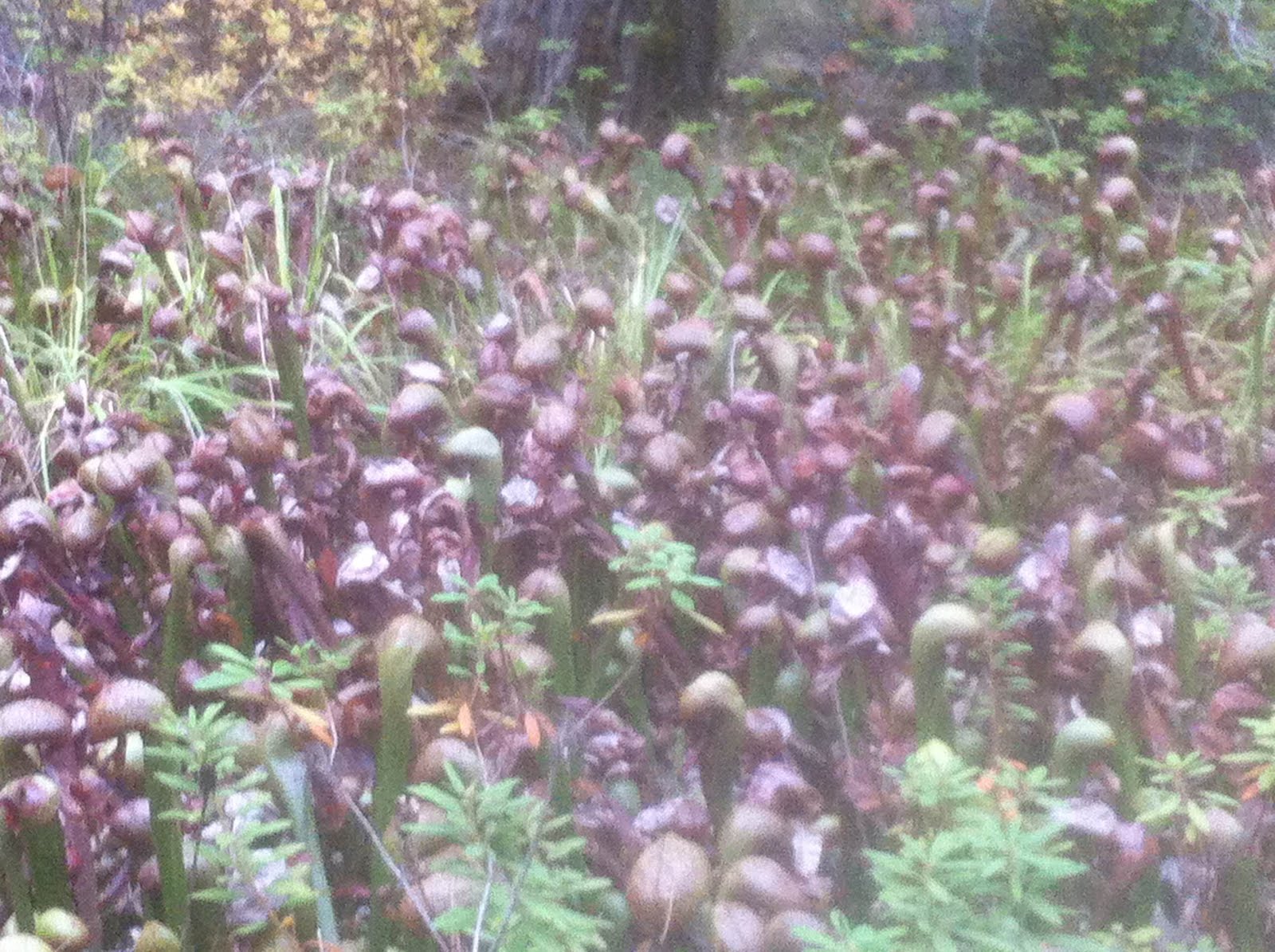
Finally, a retired couple shouted out from across the street 'do you like dogs?' and I spent 90 minutes with two huge dogs licking my ears as we drove the final stretch over the hills to the Californian coast. We stopped to see a type of insect-eating plant that only exists in the wild within a 50 mile radius of where we were. They operate like sticky plant-lobster nets and reminded me of the hattifatteners from the moomins.


A story needs space to be told. I reconnected with Nick on the way down from Vancouver – we were last together in Honduras doing some serious scuba diving – in Crescent City,and together we drove the 8 hours south to San Francisco, stopping to make a fire in a dry riverbed and sleep among those silent deities we call Giant Redwoods. Space enough to contextualise the 'whats' of our separate journeys since our last meeting with the 'why's' and 'therefores', and to find comfort in the fact that neither of us was any more settled or certain than before, and that the crossroads we were meeting at was indeed a, er, crossroads. The same crossroads. More of a spaghetti junction infact. Hence the meeting... Nick had divided his time between living on a small boat in a small town in Alaska, living a life as close to a hunter-gatherer as is possible in america. His boot was filled with jars of home smoked, home caught alaskan smoked salmon – the most incredible stuff I have ever tasted (my mouth waters now just to think about it – not sliced and salted like in the supermarket but great chunks you can fill your mouth with, moist and strong and dark red.) I asked him around the fire – my first for a couple of months – how often he found himself out in nature, cooking on a fire... he responded by telling the story of his and his partner's trip down to Mexico on a 750cc bike, camping out in the desert, rice and beans on the fire, the road unfurling in a heat-mirage of traction, until an oncoming driver misjudged an overtake one night and clipped nick's bike, sending him flying off his bike and, ultimately, into hospital, first in Mexico and then, after a 12 hour bus journey with a broken collar bone, a few fractures and a bizarre experience at the border – in Arizona.

Hospitals and health have been an ongoing theme of the trip. I saw Travis just after he had spent 3 hours on the phone to the government health insurance people (Obamacare). The American government, God Bless It, has it's own advisors on commission, trying to upsell more products to often low income, low disposable time individuals who are trying to get health insurance for the first time. To the point where they now have another service that advises people how to use the first service! It seems that the very thing that makes California such an amazing place – the constant forward thinking, innovative mindset that allows people with good ideas to rise quickly to the top – also creates the most ridiculous and damaging situations. For example

- Whilst it looks like cannabis will be legalised in california next year (as it has already been in four states), the biggest two groups lobbying against the move are current pot farmers, who currently make BIG BUCKS due to the black-market nature of the industry, and...the police, because they get loads of money to help fund the 'war on drugs' so they can buy their shiny SUVs, assault rifles etc... Blimey.

- There is a huge drought happening in California at the moment, and the central valley, which produces 40% of america's fruits and nuts (and plenty more besides) continues to suck up water at a rate that geologists say will make the valley stop being able to sustain large scale family in between 20-60 years... and the government is subsidising the water they are using to the tune of $450 million dollars a year! And we know how much of the food produced will end up in the bin... (30-40% of all food grown)

I could go on (the other big one being the massive budget cuts to acute mental health services in the state, which has naturally impacted on what is happening in the streets), but surfice to say that I am often left both baffled and frustrated, but not nearly as much as if I actually lived here.

Oakland: Succinct

And my own story? It stinks of Karma. Walking around San Francisco one day I was thinking how much I missed cycling, when I overhear a conversation between two gentlemen, who obviously know each other, one of them offering to sell the other their bike for $40. Now this was no ordinary bike – it was a beautiful, shiny-new cruiser, beige and maroon with a cup holder and – check it out – a bottle opener attached to side! Big, chunky wheels, it was the perfect complete California Chiller bike. I walked past them, crossed the road and stopped, weighing up my options. On balance, much like when you are sitting next to someone interesting looking on the bus but don't initiate a conversation, and then get off the bus wishing you had, incase they knew the secret of all life, or were your future life-partner , I thought that I would be filled with regret and 'what ifs' unless I at least enquired further about the bike.

So I went back over and began making compliments about the bike. To my feigned surprise, I learnt that the bike was on sale for just $40! Wow. Well I best have a test ride then. She was smooth and heavy and I felt about 15% cooler just sitting on her soft, faux-leather saddle. So I bought it and whizzed off to meet travis, the bike dancing round corners and purring underneath me. I imagined the envy of all the car drivers, with me so free and stately on my bike and them in mere automobiles. I bought a lock for more than the cost of the bike and rushed to get to the twitter building (unremarkable) where I was to meet Travis. I told him the story, slightly shy as the moral arguments for buying probably-stolen-bikes are I think sufficient, though not necessarily comprehensive, as I rushed to show him and get off to the pub... but where were my keys?

Within the 5 minutes of locking my bike, walking into a building, then out again, the bike lock keys had disappeared. I took all of my possessions out of my pockets/bag one by one but no bike keys to be found. So we sighed and laughed (a bit) and went to the pub, at which point I realised that during the process of looking for my keys I had infact lost my bank card. Sighs and a bit more laughter. The next day we returned, hoping for a miracle... we found a bike savaged by moonlight mechanics, and a few days after that the bike was gone all together. Ça va, ça vient...

Thanksgiving I spent with Uncle Rich and several other chaps from different walks of life, united in their love of Rich and his culinary excellence (I contributed a rather excellent sausage, leek, pecan and cornbread stuffing), in various states of glory and glorious decay (as we all are), and after a while the stories flowed – getting out of stifling towns in the middle of the country, getting into (and out of) the army (national service lasted between 1943 and 1974), childhood thanksgivings, work, migration... but there was one person missing this year, and that was Ernie, Rich's husband, who died just a few days before I arrived, after a 6 month battle in hospital.

Ernie was a quiet man who knew a lot of things and got a lot of things done. As is often the case, we find out many things about a person in the process of their remembrance that are swallowed up in the day to day 'hi how are you gosh the dog is big these days' river of blah. As I heard more and more about Ernie, his struggles and victories, his times supporting friends dying of AIDS when that disease was a dark spectre over his community, his opening line to Rich when they met at a bar on the Russian River – 'you got a light?'... and my own memories of him, missioning around in Ireland, Las Vegas, Yosemite, walking the dog, I began to understand the quote at the top of this blog a little better. In the same way universes and atoms grow according to identical geometric principles, so the wider narrative of our lives is made up of multiple mini vignettees, strung together in fibonacciesque clusters that reach for wider meaning and inform who we are. And as we get older and we have more control over what mini-stories will play out in our lives, we generally stay close to what we know and our preconceptions, and therefore our identities, are reinforced.

And none of that means we miss Ernie any less.


Wednesday, November 16, 2011

Finsbury Square Information Tent

For the last fortnight I have been wearing earplugs. The drilling in the adjacent building starts around 730am and is perceived by some as a direct provocation. It is ok for me though- the rat-a-tat-tat penetrates the earplugs in a way that the london buses, taxis, sirens, diesel generator and chatter of my fellow campers does not. And by now my subconscious knows it is time to wake up, dragging me out of whatever dream I might be meandering in and opening my eyes to judge the weather by the shade of blue on the tent canvas.

Because for the last two weeks I have been camping here, Finsbury Square, slap bang in the heart of London's financial district - the place that, much more than the puppet-filled place they call westminster further down the Thames, is controlling and suppressing the lives of people in our country and around the world.

I had initially been sceptical of the Occupy London idea - The little media that came out of Occupy Wall Street sounded amazing, and it was great to see Americans turning up the heat a little bit, especially as (as we have seen) their police state is a whole lot more hardcore than our police state - but it felt like a 'solidarity camp' wouldn't have much staying power. And initially, on the first day as the camp set itself up outside St. Paul’s (after being denied access to the London Stock Exchange, the original target), I thought I had been proven right- the amount of people was uninspiring, the rhetoric very similar to what we have had for a long while now, the police slowly kettling us. Friends of mine from SOAS, who had been deeply involved in the tornado that was last year's student demos, were openly critical. So after we had played some hot samba I got on my bike and went home.

But over the next week- I visited every couple of days- things began to get somewhat inspiring. The camp grew. The church came out in tacit support. The chef in the kitchen was an Italian with an emotional bent. Tent City University- a kind of free school set up on the camp- began a series of really interesting talks and debates. The SWP were unable to co-opt the movement. There was always a great guitar player on the steps to jam out with. Check out this video to get a feel for it http://vimeo.com/31905080

And then the following Saturday a 'tour of corporate greed' led us to Finsbury Square, where we found a girl on a tripod, half a dozen people putting up tents, and one beautiful opportunity being pegged into the ground. I decided to put my life on a momentary hold and get involved.

And so now my days are spent here, long days, sharpening my arguments with bankers, hearing stories of old Greenham Common protesters, eating great food, assuaging drunks, accepting donations, but most of all chatting, listening and figuring out SOLUTIONS.

And it is solutions that everyone wants - solutions that some members of the public practically beg us for. Trouble is - as the Daily Hate Mail media keep reminding us - we don't have one that can be summed up in a sentence. We do, though, have several short term alternatives (ending offshore tax havens, a tax on financial transactions, separating retail banking from investment banking, curtailing the powers of lobbyists in parliament, putting an upper limit on individual donations to political parties), and several long term alternatives (moving to a resource based, rather than debt based, economy; getting rid of the stock exchange; creating alternative currencies; re-organising our democracies so everyone can actually take part in decision making; un-privatising Education, transport etc.) that at the very least would redistribute some wealth and at most have the power to create the (r)evolution that is rarely talked about on camp, but that still seems like the only wholesale way out of this mess.

Because- get this- many people in the camp, perhaps the majority, believe that reforming the current system is the most desirable way of changing things. This is the reason why many of my friends- ones that are active on a whole host of different projects and who all see the need to completely rid ourselves of the current 'capitalist' system- are not participating. And the reason why we have recently taken down the 'Capitalism isn't working' banner from the front of the site.

But I digress. After 2 weeks standing at the info tent, talking to all and sundry, let me here repeat and distill down some of the conversations I have been having, so that you can comment on them, discuss with your friends and perhaps move the debate forward. This movement- the Occupy movement- will stand or fall on whether those people that don't, for whatever reason, want to camp and get directly involved, take these debates and ideas to their/your own communities, so as things in the world get even more crazy we are that little bit more prepared to articulate and action solutions.........

A man approaches...

What are you rabble doing here creating an eyesore where I normally have my lunch?

“We are here for two reasons- Firstly, to create a platform for discussion and debate both physically here as well as in the media, homes, schools and workplaces across the country. Secondly, we are here to create an example of an alternative society based on equality, pragmatism and inclusivity. A Domocracy, if you will.

But you are a magnet for homeless people, drunks, layabouts. You can't tell me they are here fighting for a better world!

It is true that by creating a safe space, with good food, understanding people and comfy sofas, people who have otherwise been marginalised from society come to spend their time. Wouldn't you? Let's blow off the media smokescreen and look at reasons for homelessness- 10% of homeless people are army veterans. Up to 20% of homeless people carry with them mental illness, 48% have drink or drug problems*.. All of them have been failed by the 7th richest society in the world, where our famous welfare state has been systematically eroded over 50 years to a shell of its former self. Society- especially this nauseatingly phrased 'Big Society'- needs to confront these problems rather than ignoring them. In our struggle at Finsbury Square and St Paul’s to be as inclusive as possible, we are doing just that.

Ah, it's alright for you to sit here smoking rollies and reeling off sob stories, but I am paying your taxes!

Many of us here work and pay taxes too, or have been made redundant by government cuts. If we hadn't spent all that money on bailing out the banks and subsequently made such deep cuts in public services, many would still have our jobs and not be reliant on benefits. So, in truth, we are fighting to get our jobs back so we don't have to be here anymore. Furthermore, we are here not for a jolly, but because we believe there are ways for us- the 99% that are not responsible for the current crisis- to have better lives, day to day.

But if we didn't bailout the banks the whole system might have collapsed!

Well, yes.

But then what would we have? ANARCHY?

Rather Anarchy than chaos. Perhaps if the banks had collapsed we would have actually had to face the causes of what had happened, and would have created a monetary system that doesn't rely on debt, rather than continuing to duct tape up our sinking boat in this, the End of Certainty (http://theendofcertainty.wordpress.com/).

As it is, many of us are still only clinging on to the life raft. A few figures: 2.62million unemployed in the UK. 21% of UK children living on or below the poverty line. 4 million people in fuel poverty (spend more than 10% of their income on heating and cooking). Average household debt (excluding morgages)£8,002** . Anti-depressants. Double dip recession. Teenagers rioting. Students rioting. Teachers striking. NHS privatising. EDL rising. Belief in the current democratic process vanishing.

And these are just the figures that can be quantified. Many people feel trapped (work, eat, TV, sleep, work, get wasted, sleep) isolated and voiceless, but worse than this, they think there is nothing that can be done! This is the biggest trick of all.

A trick? Mark my words young man, capitalism may not be perfect, but look at what happened in Russia during communism!

Calling for 'systemic change towards global equality'- the first point of Occupy London’s initial statement (http://www.guardian.co.uk/commentisfree/2011/oct/17/occupy-london-stock-exchange-occupylsx) does not mean we all need to go and live on collective farms. The strength of this movement is that there are many viewpoints and many different ideas of alternatives ways of trading and living together. This is why, at Finsbury square, we have a big 'alternatives' board that the camp and the public have been adding to. You can find it http://benoverthere.blogspot.com/2011/11/finsbury-squares-actionable-ideas-for.html

But you are- or at least claim to be- a musician. How can you critique these complex economic and sociological problems?

I am not an economist, but I have some ideas. By speaking to people right here in the city of London I hope to develop those ideas. Our Tent City University http://tentcityuniversity.occupylsx.org/ has all sorts of experts sharing their ideas, all geared towards developing alternatives.

So you are saying you don't have any alternatives?

As a matter of fact I do. In the short term, as individuals we could, for example

  • Take our money out of banks and put them in building societies or credit unions.

  • Consume less and enjoy what we do consume more.

  • Educate ourselves (youtube is great starting point) and our young people about the financial system and the power structures in our world.

  • Speak openly to our family, friends and colleagues about these issues, and take their criticisms not as insults, but as points to research further.

  • Put our time and skills into local campaigns so we see the positive and powerful effect we have when we get together.

But that's not going to bring down the banks, is it?

Not by itself. These ideas are tools to begin to realise the power we have as both producers and consumers, as both independent minds and members of our community. However, the people who control the land, natural resources, means of production and media (the '1%', though in reality it is more like 0.0001%) are not going to be persuaded to hand that over to the 99% by consensus decision making. It is doubtful even Jesus- never mind the Archbishop of Canterbury- could persuade them that happiness lies outside their air-conditioned Bentleys. The institutions that make up their web- the central banks, the IMF, the stock-exchange, international law mechanisms, our 'representative' democracy- these are rotten to the core and need to be taken apart in totality. The strength of the current capitalist system is that it is supremely flexible, with no one 'head' that can be chopped off in order to change it. We have to go for the heart. It will require some masks, and it will not be pretty.

Well, that new Thatcher film does look a bit grim... maybe you are right. But I just don't believe you can actually change anything.

History is stuffed full of seemingly unconquerable empires. Every one, save those currently tottering on the edge, has fallen. The anti-apartheid movement in South Africa and the independence struggle in India teach us three things. First, that a 1% ruling over the 99% is not sustainable and will inevitably, despite the firepower of the former, fall. Secondly, these things take time, sometimes generations, and the light at the end of the tunnel is not always apparent until you get very close to it. Thirdly, it takes a small group of people putting their head above the parapet and making enough of a stink that the framing of the debate is changed, and people start seeing that, actually, there IS an alternative. Perhaps Autumn 2011 is not going to be remembered as the time that we brought down our own imperialist rulers from the inside, but it is fact that this is the next step in a global movement gathering momentum, educating itself, fortifying itself. And I sure as hell want to be a part of it.


**http://www.creditaction.org.uk/helpful-resources/debt-statistics.html

Thursday, July 14, 2011

home

i sat on a bench behind the town hall on an evening when the sun sets late and the 8pm sky, with just a touch of pink, can be nothing but melancholy.

my eyes were still those of a traveller and i saw scarborough's calm, rippling sea, with the calm patches towards the harbour, the cliffs jutting out as fingers veering south to filey and flamborough, and the whirling, whorling seagulls tiny but significant against the sky. it was as beautiful as anything i had seen in 9 months, 17 countries and any number of stunning sunsets and sunrises.

and today i swam in the sea PROPERLY, not just the experimental diving and jumping against menacing, foamed north sea waves of yesterday.

so i am home, and it feels, well, pretty good, if a bit nervy if i look a bit deeply into myself.

i have plans, mostly a day to day plan, when i go back to london in september. one that involves lots of practicing, cooking of stews and (new one) getting the rapidly increasing homeless population interested in squatting.

but this post is a short one, just to say really

thank you

and

this is not goodbye

thank you to all the truly amazing people i have met on my way and who may or may not be reading this blog. i have learnt so much and been under the spell of so many kind and wise souls and i can only express gratitude.

and

this is not goodbye because, well, i am just a child and my journey is still in it's infancy... well maybe it's adolescence, and i hope to fill this blog with more and better in the future.

but for now i am going to stop writing for a bit, because what is going to be on my mind in the next months isn't necessarily going to be very interesting for the casual reader. however, i do intend to write this and that, so if you want to me to indulge myself and send you some different things (maybe some stories) then you can email me at clarinetmoves a t gmail dot com

or check back here in a year or two :)

Friday, June 17, 2011

Guatemala

Guatemala was a journey of four quarters, which together did not make the whole picture that let me see under the skin of this diverse and, in many ways, troubled country (an ex-army general who happily admits to extra-judicial killings is way ahead in the polls for the presidential election as he is seen as a man able to tackle the drug cartels, even though he is clearly in their employment). As such i will give you snippets:


Äre those army boots?¨

My boots had been passed back from the front of the turista minibus and the muscular guy infront clearly hoped they were indeed from the military. In that moment my train of thought joined up with the mainline and made it´s way into the central station: i had met a whole load of israeli young people in the previous week or two and despite a large effort on my part not to judge them based on the war crimes and apartheid-creating tendencies of their government, I had not been able to shake off the impression that the majority- though not all- of the maybe 2 or 3 dozen israelis that i had interacted with, were aloof, insular and often bordering on rude. this had been reinforced in some conversations with guatemalan barmen and tuktuk drivers; they stay together in groups, rarely mix with other travellers (for example, in two of the places i visited they had their own hostels) and, i was told, could be really condescending to the locals.

but then i realised- some, probably the majority, of these people were fresh out of the IDF- Isreali ´defence´force- and had been told time and again that the world had an irrational bias towards the palestinians and that they might have a hard time on the road. probably why these guys had picked a place as far removed, geographically and politically, from the whole issue as possible. and, knowing that the question ´what do you do where you come from?´is part of any good getting-to-know-you travelling conversation, and knowing that ´well, i used to be in the IDF´would cause plenty of consternation amongst us right-on, left-leaning travelling types, they probably thought ´well, why bother when i can just hang out with people who Understand?´...
and would there be any point taking up the issues- the settlements, the blockade, the water and land rights, the future´- with these young, touchy and at least partially brain-washed travelling buddies? as we hiked down to the gobsmackingly beautiful fresh water pools at semuc champey behind two ex-IDF officers, i refined and re-refined what i would say to them if they asked my opinions about the whole thing. i wanted to be clear and for what i said to be useful. ´stop building settlements... stop all restrictions on goods entering gaza... bring down the wall... stop thinking of palestinians as inferior to isrealis... accept that there will never be peace whilst israel is a state based on one religion... yes i am against zionism... no it isn´t anti-semetic to be anti-zionist... we need to bring down the governments of both america and iran before there will be a solution to this issue... no that isn´t a colonialist thing to say...´and i could see the whole conversation rolling out infront of me, with my friend´s jaw slowly tightening as he either clammed up or let his fury loose. so when we sat in the cool of the pool and he told me about his experiences in the idf i said nothing, just listened. and when he told me i should ´follow my dreams while i can´and be a musician , i did not ask him when the people of gaza, 45 percent of whom are unemployed, would be able to follow their dreams... what would have been the point? if we had become actual friends, perhaps drank some whisky together, and his respect of my thoughts was high enough and his social barriers were low enough to actually maybe listen and absorb, maybe that would have been the time...

----------

Turkey

I have concluded that the best moments of travelling happen in the in between bits, the examples of the proverb ´life is in the journey´. it is the people that take you in for a meal or for the night when you are stuck in the middle of nowhere. sharing a knowing look with a old lady on a hot day as you walk down the street. trying a new fruit bought through window of a bus.

and it was with this in mind that i began to walk around lake atitlan in the western highlands of guatemala.

after the first days hike i ended up in something between a town and a village. as i walked in a guy that turned out to be the village idiot accosted me and in turns insulted me and asked me for money. i shook him off when someone else asked me what my calabash was. for the umpteenth time i pulled it off my back, fixed the mbira in it and began to play. nhemamusasa. after about a minute i looked up to see a sea- perhaps 20- mayan women, all in exactly the same traditional dress- blue with multicoloured trim, crowding around, their small stature giving the impressiom that i was in the middle of a slowly swaying sea of egg shaped blue domes. i stopped, they laughed and passed the mbira around as i asked if anyone knew anywhere i could stay. one of the women took me down some back alleys to her house, populated by three angry dogs, a load of chickens and two MASSIVE turkeys. i laid down my things, went down to the dock of the bay and played mbira in the company of two small children, one in a barcelona shirt (there are so many barcalona shirts here- after the champions league final they let off fire crackers in the small town i was in) and watched a massive storm slowly roll in.

and then it hit and the rain sheeted down as i ran up the hill to the nearest cover- the local church. and, as i half read woodie guthrie´s autobiography (an amazing book; everyone should read it) and half listened to the (at times ear splitting) church rock band soundcheck, the church slowly filled up with maybe 100 people, all the women in beautiful traditional dress.

and afterward the best chicken and chips i have ever tasted, then the next morning i sat and played more mbira as i watched my host make fresh tortillas to go with the boiled egg and beans that were my breakfast. lovely stuff. totally random, unplannable, and what i travel for.

______

birthday in the jungle

this time last year i was trying to smooth over the rude cracks in the SOAS end of year party at Club Egg in London. There were awards to be given out (and accusations of bias to be slighted), queues and bouncers to assuage, bands to soundcheck, DJ´s egos to manage, cleanliness and sobriety to be maintained and smalltalk to be chewed out. As I rode/wobbled home at 4 in the morning, job done, with mari on the back of my bike, i vaguely thought that whatever i happened to be doing on my birthday the following year, it would be siginificantly less stressful than the night i had just had.

and, lo, june 7th 2011 was as mellow, interesting and special as all the days in my life seem to be on this road, though most of today happened to be spent on a minibus, squashed on all 4 sides by rigid guatemalan men.

We- me and shelley- were heading into the jungle. The minibus took us to a trailhead and then an 8km hike took us from the road, though fields full of cows with huge floppy ears, and into the jungle proper. The ancient mayan people built huge structures that attached to cities all over what is now guatemala, but apart from the big tourist attractions many are wholly or partly buried under the ever-returning jungle. This was one such place- silver/black stone structures prodded out of the ground, some a few feet, some 10 or 20 metres high. One would be walking along a trail and realise the steps one was walking on were clearly the original mayan steps.

But for me, just as impressive was the natural architecture: tree roots like the sprawling limbs of a giant forming natural sets of steps. Thin but immensely strong tree creepers plunging down to the ground from unseen branches above, rooted in the soil. Extended families of mushrooms colonising the forest floor and fallen trunks. Ants making 6 inch wide paths that stretch for dozens of metres in the grass between their nests and particularly tasty trees (the overall effect of this from above was like seeing a superhighway system and cemented my (and alan merriam´s) belief that ants will be the new humans once humans die out). Monkeys in the trees howling like at the dawn of creation and then, as we tracked their cries and found the trees the were in, they became silent and just hung there and looked at us, looking at them, looking at us. And down a long, winding path a big old river and a young lady slowly paddling a canoe, with her husband slinging his net.

But as beautiful as this was, the mosquitos were relentless and the heat pressed in like an overbearing auntie and sucked away energy and enthusiasm and for the first time i think ever i dreamed of the joys of a dreary scarborough afternoon.

Thursday, June 16, 2011

http://www.youtube.com/watch?v=wJ2v1Sl1nbc

I am having many amazing musical moments; this one happened to be recorded. San Christobal, Chiapas, Mexico, in one of the buildings the Zapatistas occupied in 1994... if you are in the 3 minute attention span category of listener, skip it forward to 4mins 30seconds :)

Sunday, June 12, 2011

A History- Belgrade Road Part 1

ofcourse people have been squatting in london for a long time. england's seemingly unique squatting laws were an effort to give servicemen returning from the 1st world war who had lost their homes the ability to live in empty ones left by their expired comrades. in the 70s and 80s they were the base of the civil and gay rights movements and alternative scenes in the capital- whole streets in north, east and south london were squatted, and some of our elders reminisce about that time with dewy eyed glee.


these days, for a person who sees the folly of the capitalist system and the work-survive-work-die ethos that it necessitates, squatting is one method, along with skipping, hitchiking and other creative means of living outside the system, of both ignoring and subverting this state of affairs, of living according to ones ethics and supporting the local community.


a squatted space is much more than a place to find shelter and cook food (though it can be just this too). it is a space in which a collective of individuals, lovers and sometimes families can forge a safe and creative space that is free from the stigmas and rules that have been honed over decades to make us dependent on an overarching fear that seems to pervade all the rhetoric of the mass media- fear of failure, fear of being different, fear of the 'other'. Beyond this, squatting opens up a plethora of super cool shit to be done, skills to be learnt and ideas to share. In just two years living in, visiting and partying in such places in london, i have learnt more about electrics (how to make a building safe, how to make electricity free), woodwork (how to build a room out of scrap wood) and the law (when to tell the police to fuck off; when to grab my shit and go) than i would ever have the time or the need to learn if i were renting. I have learnt how to resolve disputes in non-violent ways, how to live with people on the edge of sanity and, moreover, learn from them, how to swear in several european languages (because there are many, many italian, polish, spanish etc squatters). I have learnt the minimum of my requirments for personal space, possessions and cleanliness, and to respect that others' requirements are different and that that is cool too.


I had some inkling of these intricacies, though non of hte experience of them, when I finished university and, along with a crew of mostly fellow newly-graduated, began to walk and cycle the streets of north london looking for empty buildings.


We had a copy of the (excellent) Squatters' Handbook (available from Freedom Bookshop in whitechapel and, i think, online), but there was no book, and no up to date lists, of empty buildings to be liberated (people I know have got such lists off local councils, but for some reason we never got round to doing that). Our crew was nebulous and squat-virgin. We knew more about foucault than faucets (and i knew nothing of either), and could wax lyrical all day about the revolutionary necessity of squatting without ever having sat up all night by candlelight knowing that our only defence against the police, baliffs or indeed anyone was a plank of wood jammed between door and staircase.


But, considering all this and looking back, I think we did pretty well.


Squat 1- an empty shop with house above on a busy street in islington. Massive paintings of drunken santa claus's and upside-down jesus's denoted a former temporary christmas art squat space. We were extremely excited for all of 5 days until 6 beefy polish guys showed up in the middle of one sunday night and began crowbarring down the door. We called the police (we had the theoretical law on our side). They came, chatted with the poles, made some jokes and left. The door (and it's plank), were almost finished. They gave us an ultimatum through the letterbox with their crowbars in their hands. We left. A clever owner of a squatted building will realise that it is much quicker and more cost effective to hire some heavies to illegally evict than to go through the courts and do it legally. This, it can only be assumed, was one of those cases. The shop is now a spot to buy some polish pottery (not a joke).


squat 2- The Arundale Arms- a pub behind Dalston Kingsland that was big enough to hold our entire crew, but dark enough (all of the windows on the lower two floors had been covered with the squatter's mortal enemy- cytex) and dirty enough to drive away three or four of our original group, one of them later telling a friend 'i just don't know how people can live like that'. We cleaned the hell out of that place, including scraping pidgeon shit from the entire top floor. I had a tiny and beautiful room on the top floor of that place, just big enough for a raised bed from which one could wriggle out of the window and sit on the ledge smoking and feeling like the king of all dalston.


Then at work one day I got a phonecall, and cycled hard to find all of our things on the street, getting soaked in a light drizzle, with a couple of police vans, and my friends looking pretty shaken. The owners had come, and when we refused to leave, called the police, stating that we have caused criminal damage (a lie). This was all the police needed to get out their huge battering ram and, when they couldn't get through the front door (our wooden wedges held strong) had punched a whole straight through the back wall. Bastards. There were lots of us and we had the help of NELSN, the north east london squatters network, who recorded the whole thing (always good to have a camera incase there is any police violence or unlawful arrests) and allowed us to stay at their place up the road, an old solicitors' place, whilst we looked for somewhere else.


Squat 3- It was deep into winter by now, and we were basically couchsurfing. The cats who had been in the place up until then were really nice an accomodating, but there were many of us and we were pretty bummed out, chainsmoking and cold, and after a while it became clear we needed to leave. Along with 5 others (give or take), I slept on the ground floor, a former office with no windows, in two sleeping bags huddled next to a friend. It took a huge mental effort to get up in the mornings but, on the plus side, our hosts were skippers extraordinaire and we ate like kings.


Squat 4- Things seemed a bit desperate now and our party had shrunk somewhat, and everywhere we looked was either decrepid, unenterable or full of smackheads. And believe me we looked. All over north east london on bikes. Lists of properties made, late night excursions executed, nothing promising. We eventually ended up in a 2 room flat near manor house, squashed in and actually (for me at least) having quite a nice time being bunched up like sardines. Maybe the group at that time was special and particularly loving, but i do remember feeling a bit like being in a liferaft after a storm with the solidarity and penchant for heavy drinking that that would create.


Squat 5- A most beautiful of houses in highbury, with no sound of traffic and a huge oak tree holding firm and majestic out of my back window. The walls had beautiful murals on them painted by previous squatters and the water in the bath was hot and powerful.


But I am getting way too sidetracked. this is a post about 2a Belgrade Road.


We lasted at the Highbury place a couple of weeks with an eviction date from the previous squatters fast approaching. We had a list of buildings, prioritised according to their potential, and had been systematically checking them out- a former meat packing house near smithfields market that was the first place to really scare me as Bob climbed up a metal ladder to the electric box and prodded around, me with a fist in my mouth, shitting myself he would electricute himself. Terrace houses with neighbours calling the police. Town houses with concrete poured down the toilets (to ward off scum like us)... the last place on our list was a warehouse-looking building just off Dalston high street, with a big gate shrouding a huge metal door. Late one night three of us with our best jedi robes uttered the magic words and the big, black door opened to reveal a big room, the size of a 5-a-side football pitch, a bright lamp still lit, illuminating a floor filled with miscelannious crap- videos, speakers, a monopoly set, shopping trolleys, empty cans, furniture- all over the floor, as if the former residents had had a little 'throwing things around' spree before they left. The walls were covered in pretty artistic graffiti, dominated by a capitaled, iron-coloured sign with each letter as big as a big man- 'DIY OR DIE'. We ventured quickly up the dark staircase to the second floor, and found a similarly sized open plan room with a similar mix of crap all over the place. Another staircase led higher, but this was not the moment for surveys, and we popped on our D-lock and reported to base.


It was November 2008. We were so happy to find somewhere, anywhere,to stay that the full potential of the space did not dawn on us immediately. We sat in a small room off the big one on the ground floor, keeping warm and considering how to put in a new lock on the steel door. Soon enough though, our excitement of the possibilities of that place was piqued. We learnt (i can't remember how) that the previous squatters, mostly spanish, had got an eviction notice and left in a hurry. Their legacy was the mess, a big ass stash of needles that had apparently been used to mainline ketamine btu that had been put neatly in a sharp box, the graffiti, some rotting food in the fridge and, on the top floor that we had not initially explored, a patchwork of plywood, struts and bits of huge material that made up around 6 rooms- some complete, some collapsing, some just mounds of wood, that together gave the top floor the appearance of something between a shanty town and an extended treehouse. It was {beautiful}.


The sign on the wall read '100 flowers cultural centre' and we found many documents about various liberation struggles in turkey and kurdestan. the 100 flowers was a phrase coined by mao during the cultural revolution, and had been taken on by the PKK and, in this deeply turkish area of dalston, had it`s share of revolutionary history, though most of our crew thought that the maoist connotations and the , er, flowery name meant we should disgard the namesake and the place became known simply as 2a belgrade road. one day, however, an old woman died down the street and her belongings, which included over 100 plastic flowers, were donated to us. someone tied 100 of them to our gates.